AI in Manufacturing Quality: 5 Emerging Applications to Watch

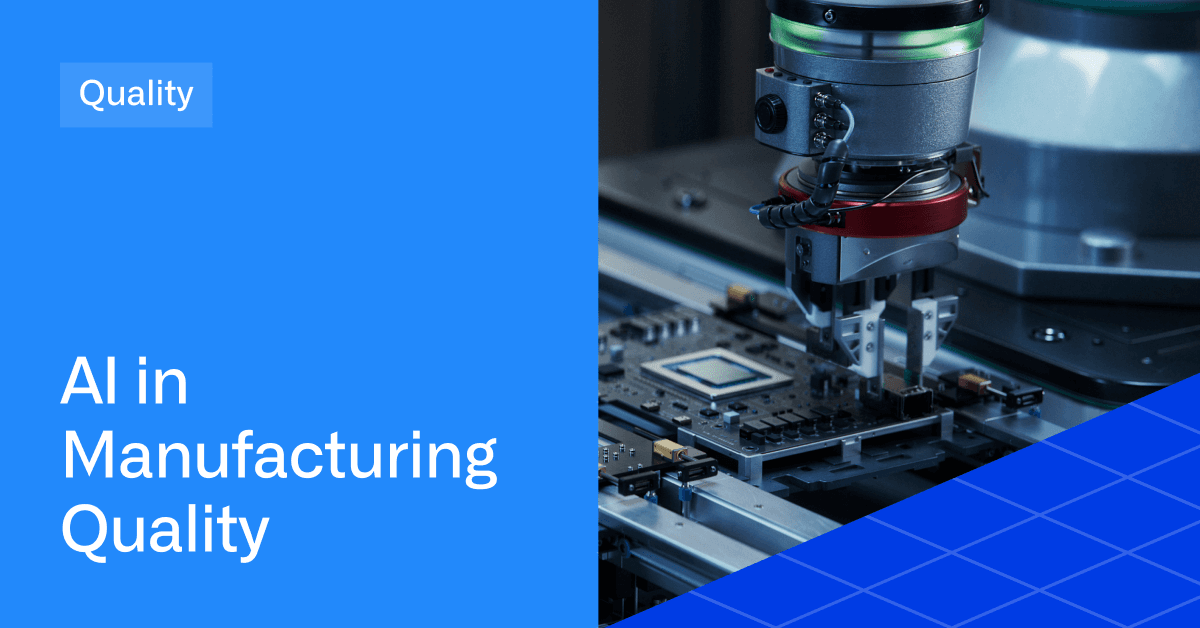
As artificial intelligence (AI) continues to push the boundaries of what’s possible in manufacturing, many in the industry are wondering how the technology will reshape quality management.
The core driver behind AI’s seismic impact, in many use cases, is the ability to process and make sense of huge volumes of data at a speed that’s never been possible before.
While some AI-driven quality advances are still on the distant horizon, others are rapidly transforming how quality teams detect and prevent quality issues. Below, we examine five emerging quality applications of AI in manufacturing, as well as their current limitations and challenges.
1. AI for Equipment Maintenance
AI for equipment maintenance has the potential to significantly impact quality because it directly addresses variation reduction, which is the core driver of quality improvement.
This technology will allow manufacturers to move beyond reactive maintenance and predictive maintenance towards truly prescriptive maintenance, where teams replace components before problems occur based on AI-detected performance changes.
Consider, for example, how you ensure a machine feeds material at precisely the same rate every time:
- You need consistent hydraulic pressure
- To maintain hydraulic pressure, the pump must function properly
- For the pump to function properly, seals must hold fluid without degradation
This cascading relationship from product quality back through multiple mechanical systems is an area where AI shows huge promise. AI also enables continuous monitoring and analysis of parameters like pressure, temperature, and flow rate.
By tracking these parameters continuously as opposed to taking discrete measurements, plants can identify trends before they become failures. When hydraulic pressure begins to vary, for instance, AI systems can trace the issue to a specific component to enable proactive replacement.
The biggest challenge here is developing the knowledge base AI needs to understand that varying hydraulic pressure might indicate a failing pump seal, a worn impeller, or motor voltage issues. This level of diagnostic intelligence requires substantial upfront work to implement, as well as ongoing monitoring and maintenance of AI models. While maintenance AI represents the future of variation control, companies shouldn’t underestimate what it takes to build and manage this type of system.
2. Continuous Equipment Monitoring and Adjustment
In addition to proactive maintenance, forward-thinking manufacturers are exploring how real-time, AI-driven equipment adjustments can help maintain performance rather than waiting for operators to notice and correct process drift.
For example, these systems might:
- Increase feed speed when pressure drops slightly
- Adjust coolant flow rates when temperature rises
- Modify other process variables in response to detected changes
These continuous, automatic adjustments can help maintain tighter process control by proactively identifying and correcting issues that humans might otherwise miss.
Implementation, of course, depends heavily on the production environment. High-volume, low-mix operations with consistent product and process parameters (think dairy processing facilities filling gallon jugs of milk) are the ideal scenario for this type of application.
Low-volume, high-mix manufacturers face a steeper challenge. When you’re producing different parts with different specifications across the same equipment, developing AI systems that can adjust appropriately for each scenario becomes exponentially more complex.
3. Automated Inspection of Complex Defects
Some quality issues have historically gone unchecked simply because they were difficult or impossible for humans to inspect reliably. Microscopic cracks in welds, internal structural defects, and other subsurface problems fall into this category. AI-powered inspection technologies are changing that equation to enable faster, more accurate defect detection.
AI combined with eddy current testing systems, for instance, can automatically inspect welds and detect microscopic defects invisible to human inspectors. Similarly, AI-enhanced X-ray systems can identify internal flaws in castings or assemblies. These automated inspection capabilities enable manufacturers to check features that were previously assessed only through destructive testing or statistical sampling, if they were checked at all.
4. AI-Powered Employee Training Deployment
Where creating training materials used to be a lengthy process, AI now makes it easy for manufacturers to build training programs that reflect how work actually gets done.
For example, manufacturers can quickly turn standards and SOPs into step-by-step training modules, embed video into on-the-job training materials, and give workers instant access to visual guidance as they perform tasks.
For organizations managing hundreds of employees performing diverse tasks, AI-driven training development offers unprecedented scalability in terms of:
- Capturing tribal knowledge
- Reinforcing knowledge on the plant floor
- Delivering targeted retraining in response to specific issues
5. Next-Generation Vision Detection
One of the earliest AI applications to gain traction in manufacturing, vision detection systems have now become widespread across industry for automating manual inspections.
The next step in the evolution of vision detection is using the technology to monitor manufacturing processes themselves, as opposed to just defect detection. High-speed forging operations, for instance, have seen remarkable success using vision detection systems that can detect double-hits in milliseconds, allowing operators to stop the press before catastrophic tool damage or safety incidents occur.
Like any quality initiative, however, success with this and other AI solutions means going beyond just detection to enact true preventive measures. In other words, it’s not enough to detect the impending double-hit. You must also ask why it occurred in the first place to be able to prevent it in the future.
We’re only just seeing the beginning of how AI will positively impact quality. As these AI capabilities continue to mature, the technology will continue pushing manufacturing closer to the vision that Industry 4.0 has long promised.
Success requires matching the right AI application to specific jobs to be done, while remembering that even the most sophisticated technology still needs human expertise to guide it.
