Your Quality Data Is Only as Good as Who Generated It

Most manufacturers have a qualification requirement for their internal auditors. Very few have a system that enforces it. Here’s what that gap is costing your audit program and how to close it.
Manufacturing leaders run their operations on data.
Data from sources like their ERP. Or from their MES. Even the data from their audit results. That data informs decisions at every level of the organization, from the plant floor to the boardroom. It shapes how leaders assess risk, respond to customers, prepare for certifications, and prioritize where to focus next.
But here’s a question most organizations haven’t directly asked: how confident are you that the data your quality system is generating is actually reliable?
Not because of a technology failure. Because of how the data was generated, and who was generating it.
There are two layers to that problem. Most manufacturers have only addressed one of them.
The Decisions Running on Your Audit Data
Before examining where the reliability gaps come from, it’s worth being clear about what’s at stake.
For VPs and Directors of Quality, audit data underpins certification readiness, informs customer conversations, and shapes how systemic risk gets assessed and reported. For Plant Managers and Operations Directors, it’s the picture they use to understand overall process health, compliance readiness, and where operational attention is needed. For Quality Managers and Quality Systems Managers, it’s the daily feed that drives finding trends, corrective action prioritization, and program performance reporting.
Audit data isn’t a quality department concern. It’s an operational and strategic input at every level of the organization. When it’s compromised, even partially, every decision built on it is weaker than it looks. And in most manufacturing operations, there are two distinct ways it gets compromised, often simultaneously.
The First Layer: How Audits Are Conducted
The reliability of audit data starts with the conditions under which audits happen. Even before asking who is performing them, there are four factors that directly affect whether the data coming out of an audit program can be trusted.
Timeliness. Paper-based audit processes create lag. By the time results are compiled, reviewed, and shared, the moment to act has often passed. Leaders making decisions on last week’s data are always a step behind. When audit results are captured digitally and made visible in real time, issues surface the moment they’re found, not days later when the window to respond has closed.
Knowing what good looks like. An auditor can only identify a problem if they know what to look for. When auditors are working from memory or a bare checklist with no supporting context, findings become inconsistent. Embedding reference materials, photos, and standards directly into the audit at the point of execution gives auditors the context to make accurate, consistent calls, regardless of experience level.
Audit fatigue and pencil whipping. Repetition breeds assumption. When the same questions appear in the same order every day, answers become automatic rather than observed. Auditors stop looking and start checking. Dynamic question sets that vary with each audit break that pattern, requiring genuine attention and observation every time rather than muscle memory.
Consistency across shifts, areas, and sites. Informal or paper-based processes produce results that reflect the person running them as much as the process being audited. When every auditor works from the same structured digital workflow, the data becomes comparable across shifts, areas, and sites, giving leaders a picture they can actually analyze rather than interpret.
These factors are addressable. The manufacturers closing these gaps are producing audit data their organizations can act on with confidence. But there is a second layer to the reliability problem, one that most organizations haven’t systematically tackled, and it has nothing to do with the process itself.
The Second Layer: Who Is Conducting the Audit
Here’s the part most audit programs haven’t solved.
Even with real-time digital capture, embedded reference materials, randomized question sets, and structured workflows, audit data is only as valid as the qualification of the person generating it. Consider what’s at stake across three of the most common audit types in manufacturing operations.
Internal and quality system audits. Auditing a quality management system against ISO 9001, IATF 16949, AS9100, or similar standards requires documented auditor competency. When an unqualified person conducts this audit, the result isn’t just unreliable data. It’s an external audit finding waiting to happen.
Process audits. Evaluating whether a manufacturing process is executing to its control plan requires technical knowledge of that process and its known risk points. An auditor without that background can check boxes but can’t evaluate whether what they’re observing represents a real deviation. Findings get missed, and issues flow downstream into production and corrective action backlogs.
Safety audits and behavior-based safety observations. Identifying at-risk conditions and behaviors requires trained observation skills and familiarity with the specific hazards in a given environment. An unqualified observer may complete the audit on paper while missing the conditions that matter most. In high-hazard environments, that gap doesn’t produce a compliance record problem. It produces a safety incident.
Across all three, the pattern is the same. An audit conducted by an unqualified person produces data that looks valid on the surface but can’t be trusted when it counts.
Most manufacturers have qualification requirements for their internal auditors. That’s not the gap. The gap is systematic enforcement of those requirements at the point where it matters most, scheduling.
When the qualification check is manual, it puts everything at risk. It’s a separate step that depends on the scheduler knowing who is qualified, where that information lives, and whether it’s current. Sometimes it’s a spreadsheet. Sometimes it’s a shared folder on a network drive. Sometimes it’s institutional memory held by one person who happens to know that a particular auditor completed their training two years ago.
That system works until it doesn’t. And when it breaks, the consequences don’t announce themselves immediately. They show up later, as a finding that should have been caught, a corrective action built on a compromised audit, or an external auditor asking who performed a critical internal audit and whether they were qualified to do so.
Most organizations don’t have a clean answer to that last question. That’s the vulnerability.
And it’s not an isolated one. Quality certification experts analyzing nonconformance patterns across IATF 16949, ISO 9001, AS9100, and related standards consistently identify inadequate auditor competence as one of the most common deficiencies in internal audit programs. Across industries and standards, the absence of a defined process for verifying and maintaining auditor competency appears as a recurring external audit finding, often going undetected for years until a certification body auditor looks closely enough to find it.
What This Means at Every Level of Leadership
The qualification gap in audit programs isn’t felt the same way across an organization. But it creates risk at every level.
For VPs and Directors of Quality, the exposure is systemic. Compliance records, certification readiness, and customer-facing quality commitments are all downstream of audit data. If that data was generated by unqualified auditors, the defensibility of everything built on it is in question. Certification bodies and customer auditors are specifically trained to ask whether internal auditors were qualified. Most organizations aren’t prepared for that question.
For Plant Managers and Operations Directors, the risk is operational. They rely on audit results to understand whether their processes are running the way they should. When those results are generated by auditors without the qualifications to properly assess what they’re looking at, the picture is incomplete. Problems that should have been visible stay hidden, and operational decisions get made on data that doesn’t reflect reality.
For Quality Managers and Quality Systems Managers, this is a daily burden. They know the qualification requirement exists. They’re the ones managing it manually, cross-referencing spreadsheets, relying on memory, and hoping the person who scheduled the last audit remembered to check. The system depends on them catching it every time. That’s not a system. That’s a workaround.
The common thread across every level is the same: a qualification gap in the audit program creates a data reliability problem that compounds quietly over time, until a major issue surfaces it.
What Solving Both Layers Looks Like
Closing the audit data reliability gap requires addressing both layers together. The first layer is about how audits are conducted. The second is about who is qualified to conduct them. When both are in place, the data coming out of an audit program earns a level of trust it can’t have otherwise.
On the process side, that means digital workflows that capture results in real time, give auditors the context to make accurate calls, prevent the pattern of rote repetition that erodes data quality, and produce consistent results that leaders can compare and act on across the organization.
On the qualification side, it means connecting qualification requirements directly to the scheduling process. Not as a policy that depends on the right person remembering to check. As a systematic control that ensures only qualified auditors are assigned to the audits that require them, every time, without adding administrative burden to the people running the program.
When these two things work together, the result isn’t just better audit data. It’s an audit program that leaders at every level can actually stand behind. Findings are generated by people qualified to find them. Corrective actions are based on data that can be defended. Compliance records reflect what actually happened, by the people authorized to assess it.
That’s what audit program integrity looks like. And it’s now achievable inside a single platform.
Introducing EASE Auditor Qualifications
EASE is the audit and inspection platform built for manufacturers. Thousands of manufacturing teams use EASE to digitize their audit programs, capture findings in real time, close corrective actions, and give leaders visibility across every site and shift. The capabilities that address the first layer of the audit data reliability problem, real-time digital capture, embedded reference materials, dynamic question sets, and consistent structured workflows, are core to what EASE does every day.
Now EASE addresses the second layer.
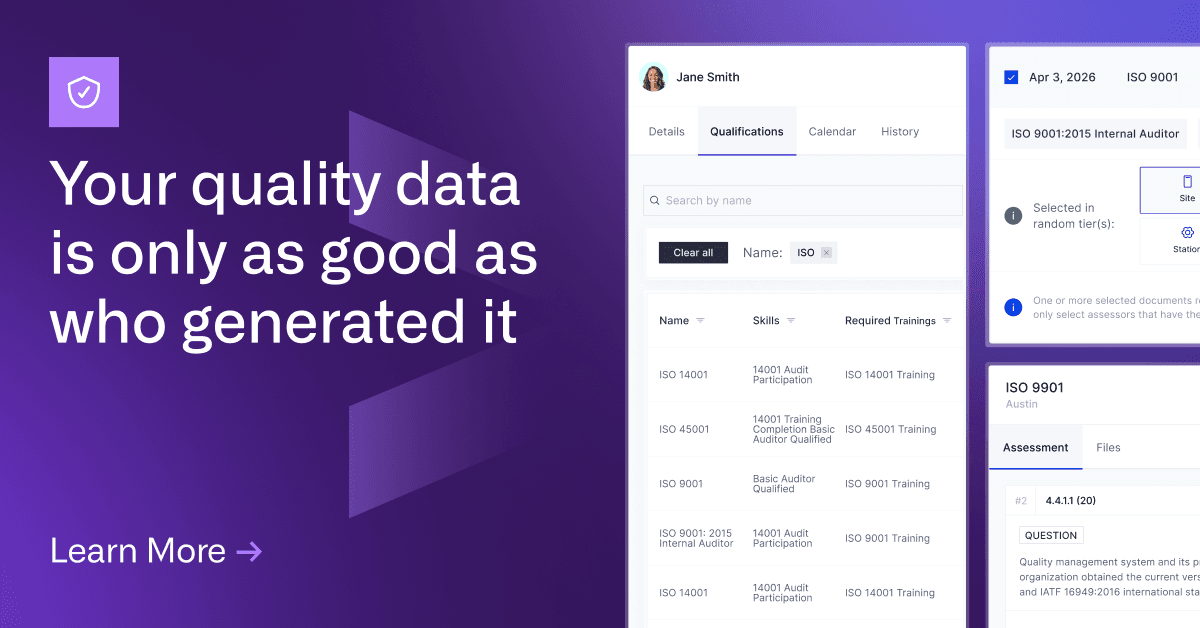
EASE Auditor Qualifications, available in EASE PRO, connects qualification requirements directly to audit scheduling. Admins define qualifications, attach them to the audit documents that require them, and let the platform do the rest. When it’s time to schedule, the system warns schedulers if a selected person doesn’t meet the qualification requirements for a specific audit and keeps unqualified personnel off those audits automatically. No manual check. No separate spreadsheet. The control is built into the scheduling process itself.
And for teams using On-the-Job Training in EASE, the loop closes completely. When a team member completes the required training associated with a qualification, they earn it automatically. That qualification then flows directly into scheduling eligibility.
Train. Qualify. Audit. With EASE.
Every audit in qualified hands. That’s not just a goal. With EASE Auditor Qualifications, it’s how your audit program runs.
Next-Level Audit Integrity
The data running your quality system is only as good as the people and processes generating it. Some manufacturers have made real progress modernizing how audits are conducted. Many are still running on paper, spreadsheets, and manual processes that leave too much to chance. And across the board, the qualification side of the equation has been left to the same manual workarounds that create the very gaps this post is about.
EASE Auditor Qualifications changes that. One less thing to manage manually. One more reason to trust your audit program.