Make This World Quality Month Count

Every November, manufacturing and quality professionals mark “World Quality Month.” It’s a timely reminder that quality isn’t a check-the-box activity; it isn’t an event; it’s a culture and a clearance lens through which every process, every decision, every output must be viewed.
For manufacturers, this shouldn’t be a mere feel-good campaign. It should be embraced as a strategic imperative. With global supply-chain fragility, tighter margins, rapidly evolving regulations and the ever-present risk of quality escapes, the cost of getting it wrong is higher than ever.
At Ease.io we believe World Quality Month offers more than awareness. It presents a pivotal point for those who want to make a fundamental impact in their organization: a chance to elevate quality from reactive fixes to proactive, data-driven frontline performance. Because quality isn’t just the output; it’s the workflow, the audit, the engagement of teams on the plant floor, the visibility of issues, and the timeliness of resolution.
The story we’re often missing: Quality as frontline empowerment, not just management mandate
We’ve all seen it; many quality programs default to “top down” policies: define standards, audit compliance, fix failures. Our recent proprietary research revealed a stark disconnect. Leadership is overwhelmingly confident in its quality culture, while frontline operators are far less sure.
In other words, we talk about quality from the top, but the people doing the work don’t always feel it, see it, trust it.
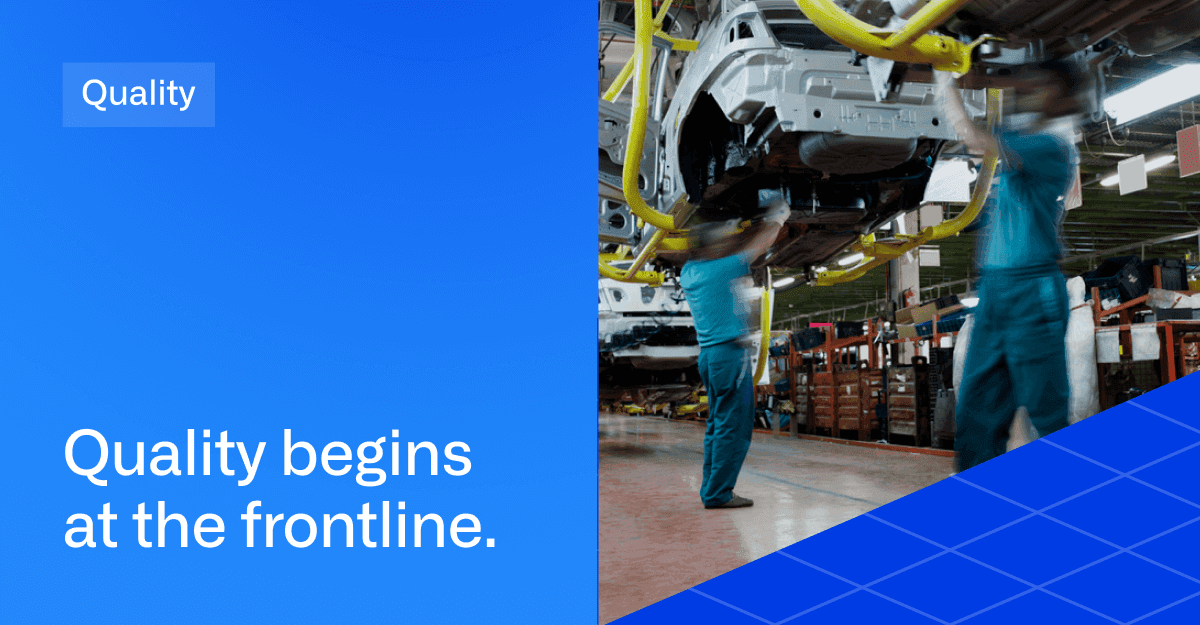
This is the shift we want to underscore during World Quality Month: Quality begins at the frontline. It lives in the ability of both operators and auditors to raise issues easily, and in the feedback loop that turns those issues into improvement.
And that means:
- Your audit tool must be mobile, simple, intuitive, and easily accessible for operators and auditors.
- Data must flow upward and outward making issues, resolution status, and trends visible in real-time, to the right stakeholders.
- Issue resolution must be closed-loop, meaning when a non-conformance is found, you can’t stop at “we logged it”; you must act, track, and learn.
Why quality must be reframed as prevention and visibility, not only detection
Historically, quality has been rooted in defect detection: find the bad part, reject it, clean it up. But in a world where speed, scale and complexity are only increasing, that is not enough. As we emphasize during November, the real value lies in preventing escapes before they become cost centers. This means having visibility into process risk early is paramount.
But prevention and visibility require a different mindset:
- Shift audits from reactive checklists to scheduled, risk-based, routine plant floor activities.
- Give frontline teams the tools (and psychological safety!) to report and escalate issues as they arise, not days or weeks later.
- Aggregate data across sites, so leadership sees not only where the defect occurred, but where systemic process gaps exist.
During World Quality Month, ask yourselves: “Could we have caught this earlier? Did someone have visibility? Did we act in time?”
3 practical themes to make this World Quality Month count
1. Re‐engage the frontline
Quality isn’t just a QA department’s responsibility. It’s the operator’s job, the team-lead’s responsibility, and sets the plant-floor culture in motion.
- Enable the frontline: Bring audits into the mobile world, give operators the tools and voice to record findings easily.
- Close the loop: Ensure findings lead to corrective actions, root-cause investigations and, most importantly, visible fixes! Without that, audits feel pointless.
- Train in context: Embed on-the-job training tied to known failures, so quality becomes a skill, not a task.
2. Use data to drive conversations, not just reports
Numbers alone won’t change behavior. But the right metrics, visualized clearly and discussed regularly, will.
- Use real-time dashboards and reports that show trends in non-conformances, repeat findings, and mitigation times. With tools designed for plant-floor realities.
- Pick one quality metric for World Quality Month, for example, “repeat findings in the same location by the same operator” or “time from non-conformance to corrective action” and rally around improvement.
- Make quality visible at every level: the operator sees their part, the supervisor sees site‐wide, and leadership sees enterprise trends.
3. Celebrate the wins and amplify the culture
Quality improvements don’t happen overnight, but when they do, they matter. Use World Quality Month to spotlight progress:
- Recognize teams or operators who found meaningful issues, fixed them, and prevented customer impact.
- Share case studies: “Here’s how plant X reduced scrap by Y% in 60 days after doing Z.”
- Embed the mindset: quality is more than compliance; it’s customer trust, brand reputation, and employee pride.
At Ease.io I’ve seen companies make a significant impact by catching issues early through well-structured digital audits, closing the loop on previously disconnected processes and giving all stakeholders, from the frontline worker to the C-suite, the data visibility they need to drive change.
One recent success story that comes to mind is that of our customer, American Woodmark. The team led by Anne Trobaugh, VP of Quality & Customer Experience, implemented a unified quality strategy across 16 plants. The strategy had proactivity, frontline enablement, and data at its core, with leadership involvement deeply ingrained throughout. If you’re interested, you can learn more about their approach and results here.
Stories like American Woodmark’s are the ones that help quality become a lived behavior, not a metric buried in a deck or Excel spreadsheet
The angle we believe in: Quality as continuous frontline visibility + digital-first workflow
If you’re still thinking “should we digitize?” I encourage you to ask instead, “how fast can we?” Whether you consider EASE or not, you still need to connect the plant floor, managers and senior leadership with actionable insight and enable a closed-loop corrective culture in order to enable impactful change.
In the context of World Quality Month, it means this:
- Don’t treat November as a one-time push. Use it as the launchpad for ramping up solid audit workflows.
- Use it to renew your frontline-leadership alignment: review how operators feel about quality culture, how confident they are in processes and tools (our research shows the gap is significant)
- Use it to declare a new baseline: for instance, “By next June, we’ll reduce repeat findings by X% and shorten time from non-conformance to corrective action by Y%.” Then use every audit, every data point, to measure progress.
Final Thoughts
You will gain more by enabling everyone to report issues immediately rather than using the game of telephone that is likely in place today. You will gain more by making data accessible and actionable than by compiling quarterly slide decks. You will gain more by closing issues quickly than by letting them linger.
Quality is not a destination. It is a journey. And every journey begins at the point of action: the machine, the operator, the line, the shift.
November is a reminder, but the transformation you want lasts all year. Let this World Quality Month be your turning point, the moment you refocus from “audit and comply” to “see and improve,” from “quality is responsible for quality” to “we all own quality,” from “react when we fail” to “prevent before we fail.”
When quality lives in your workflows, your margins improve, your customer trust deepens, and your teams feel the difference. That is the outcome we all want.
Here’s to a strong World Quality Month and making it the start of something bigger!
