Agentic AI for Manufacturing: What It Is and Why It Matters

A team lead conducts a first article inspection on a station at the start of first shift, signing off when the part passes.
Two hours into the production run, the torque setting on the machine starts to drift. Small enough that operators don’t catch it, but big enough that the parts coming off the line are now out of spec.
Because the next check isn’t until the start of the next shift, hundreds of parts have already moved downstream by the time someone spots the issue.
This is just one scenario that highlights why the future of manufacturing quality lies in agentic AI, a technology Gartner describes as “a goal-driven digital workforce that autonomously makes plans and takes actions.”
This shift is happening fast. Gartner forecasts that 40% of enterprise apps will feature task-specific AI agents by the end of 2026, up from less than 5% a year earlier.
On the plant floor, however, that means something more specific than the typical AI agents or predictive analytics pilots most leaders have seen so far. Below, we explore what agentic AI in manufacturing is and why it matters, with real examples of how plants are using it today to improve quality and safety performance.
Learn more about Using Automated Visual Inspections to Enhance Manufacturing Quality.
What is agentic AI in manufacturing?
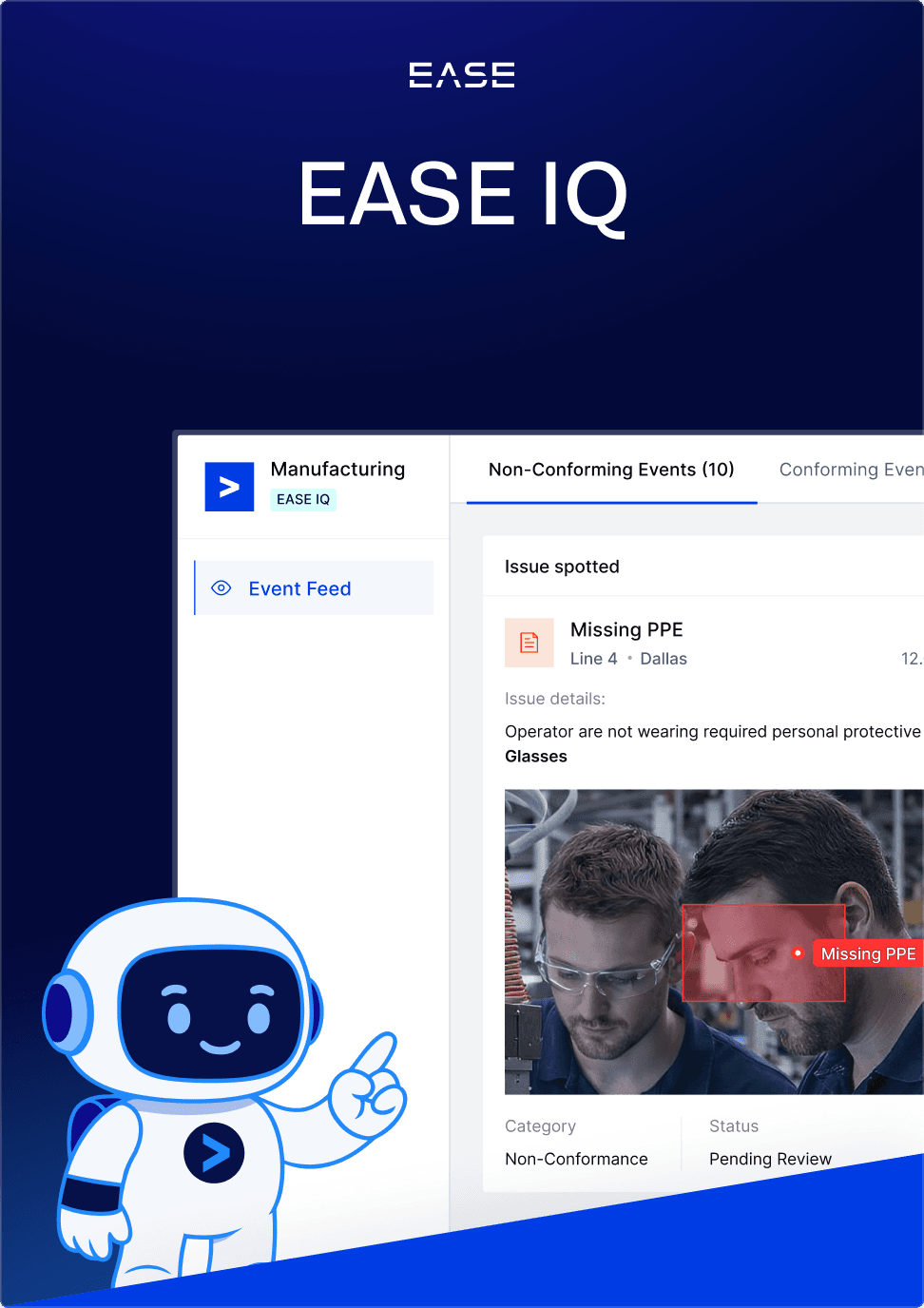
Agentic AI in manufacturing refers to systems that monitor real-time production conditions, make decisions about what needs to happen next, and initiate action without prompting at each step. On the manufacturing floor, that translates into systems that watch for non-conformances and trigger corrective actions, tracking them through to closure.
What makes an AI system agentic comes down to a few defining characteristics:
- Goal-driven: It works toward an outcome, such as a quality target or a safety standard.
- Autonomous: It decides what to do next based on what the camera, sensor, and machine data are showing vs. what the reference standard is.
- Action-taking: It triggers actions, such as launching a corrective action and notifying a supervisor when a part doesn’t meet spec.
- Context-aware: It interprets real-time conditions on the plant floor and adjusts its response to the situation.
- Closed-loop: It tracks the actions it triggers through to verified resolution.
The action piece is what makes it different from the generative AI systems most plant leaders are already familiar with. Think ChatGPT and the dozens of corporate AI tools that summarize reports, draft emails, and answer questions when prompted. Useful in certain contexts, but limited to producing content when you ask.
Agentic AI vs. generative AI in manufacturing
The biggest difference between agentic and generative AI is that agentic AI can take action, whereas generative AI only produces content based on a prompt.
In other words, generative AI talks, while agentic AI works.
In manufacturing, you can prompt a generative AI tool to:
- Summarize corrective action and problem-solving reports
- Pull up specific documents within a knowledge base
- Draft first versions of SOPs and work instructions
- Explain technical specifications or quality requirements in plain language
- Generate training module quiz questions based on documented procedures
Instead of waiting for a prompt, an agentic AI system can be configured to execute more complex tasks from start to finish independently. It watches continuously, decides, and acts based on the goals and rules you set. People still make the judgment calls, while the agent handles routine responses without delay, rather than having to wait for a person to get to that task. Examples include:
- Pulling a part for quarantine when an inspection flags a defect
- Notifying maintenance when a machine setting drifts out of tolerance
- Assigning a corrective action to a specific operator or line lead
- Escalating a finding when corrective action hasn’t been taken within a defined window
The reason this matters is that the two types of AI are designed for two different jobs. Generative AI helps people do their existing work faster, like writing a report or summarizing a meeting. Agentic AI does work that no human is currently doing on a continuous basis, such as watching every workstation, every shift, and acting the moment something is off.
How does agentic AI work in manufacturing?
Agentic AI on the plant floor is typically built around several core inputs:
- Camera vision that captures visual conditions on the line, including operator activity, product appearance, PPE compliance, and 5S layout
- Machine sensors and IoT devices that capture measurable conditions, like torque values, temperatures, pressures, cycle times, and vibration patterns
- Existing data systems that contain context such as work orders, standard procedures, training records, and prior corrective actions
Together, these three streams give agentic AI systems the full picture of what’s happening, what should be happening, and what to do about the gap between them.
What are some applications of agentic AI in manufacturing?
Leading manufacturers are already starting to deploy agentic AI for multiple applications, helping them spot issues earlier and act faster. These use cases include:
- Automated product inspections via camera vision to identify non-conforming parts before they’re shipped
- Machine setting monitoring to ensure process inputs are correct
- Safety compliance monitoring such as watching for correct PPE, machine guarding, and lockout/tagout (LOTO) procedures
- Process verification to confirm operators are following key steps of work procedures correctly
- Predictive maintenance to detect emerging equipment issues from sensor and machine data before they cause downtime
- Continuous coverage between scheduled checks, so non-conformances are caught the moment they happen, rather than at the next audit
The three gaps agentic AI fills on the plant floor
One way to think about agentic AI is in terms of the gaps it addresses in plant floor operations today. The biggest of these are accountability, intelligence, and closed-loop action.
Accountability
When something goes wrong, the data trail behind it often doesn’t exist. Who was at station 4 when the torque drift started? What were conditions at the time? When was the issue caught, and who responded?
Because plant floor operations are largely a black box, operations and quality leaders are often forced to make decisions based on incomplete data. Improvement then stalls, because no one is getting the full picture of the situation.
Continuous monitoring via agentic AI fills that gap. Instead of periodic checks that represent a snapshot of conditions, manufacturers get a continuous record of what’s actually happening minute-by-minute on the plant floor.
That’s the foundation for real accountability. Not blame, but the line of sight that lets leaders identify what’s working, where ownership sits, and what specifically needs to change.
Intelligence
Manufacturers capture enormous volumes of data in MES, MOM, QMS and ERP systems. This raises questions like:
- Is the data getting where it needs to go?
- How can we make sense of the data?
- Are we losing key insights in translation?
This is where agentic AI comes in, acting as a traffic cop for data. It surfaces patterns and finds the signals that matter, helping separate those signals from noise within the data. In essence, it gives people real intelligence they can act on, faster than they would ever be able to process it themselves.
Closed-loop action
All of this data generated by modern manufacturing systems is only as valuable as the improvements you’re able to make with it. Once you have the data, what actions do you take and how do you orchestrate them?
For an illustration, let’s look at the earlier example of a torque tool drifting over the course of a shift. When the torque tool drifts out of spec, an agentic AI system doesn’t just send an alert. It also:
- Opens a corrective action assigned to the line lead
- Attaches the data showing when the drift started and how many parts were affected
- Routes the fix through the right channel, such as a tool re-calibration, tool swap, and possibly a re-torque of affected parts that have already moved downstream
- Verifies that the problem was solved by continuing to check the process
The action is tracked through to this verified resolution before the work order closes. Real accountability requires data flowing into action, and action flowing into verification. The closed-loop layer is where that actually happens.
Augmenting, not replacing, employees
Agentic AI isn’t about replacing employees. It’s about putting more eyes on the process, generating insights from the flood of data that plants can’t currently contend with, and giving teams the tools to correct problems faster.
Routine monitoring and follow-up become automatic, leaving decisions in the hands of people who bring judgment and problem-solving skills to the equation. Plants determine data and conditions to monitor, and any action taken by AI systems is constrained by pre-determined rules and approvals.
If you’re wondering how agentic AI could improve your operations, start with the question that frontline leaders should already be asking: Is your process being performed the way it’s supposed to be, when it’s supposed to be? If you can’t answer that without sending someone out to look, that’s where agentic AI can make the biggest difference.