AI in Quality Management: 6 Use Cases Driving Real Value


Ask manufacturers where they’re getting value from AI today, and the answer isn’t a futuristic vision of fully autonomous smart factories.
Rather, the value is showing up in less glamorous places, like the documentation and coordination work that tends to consume the lion’s share of the quality team’s time.
Today’s post looks at six of these use cases for AI in quality management, and the pitfalls teams need to be aware of.
Learn more about how AI can accelerate problem-solving in our recent podcast: 4 Ways AI Can Actually Speed Up Problem-Solving on the Manufacturing Floor
1. AI for Manufacturing Problem-Solving
Applying AI to tools like 8D problem-solving is a fast-growing focus in manufacturing. One key advantage AI provides over simple keyword search is semantic matching.
For example, you can ask AI about a surface defect in a painted part, and it also finds reports filed under “paint defect,” because it recognizes that both describe the same problem.
AI accelerates 8D problem-solving in several ways, including:
- Problem definition: AI can draft problem statements from scrap data and production records.
- Mining past 8Ds: AI can quickly surface related 8Ds to reveal similar problems and how your team solved them in the past.
- Data analysis: AI can surface correlations across thousands of data points per unit, so engineers can focus on the variables that matter most.
- Documentation updates: Once an 8D closes, AI can update the process failure mode and effects analysis (PFMEA) and control plan and draft new layered process audit (LPA) questions to verify against. This can compress eight hours of work into under an hour.
Note that while AI can propose causes faster, a solution pulled from another plant’s 8D may not apply to your process. Verification still belongs with the team.
2. AI-Assisted FMEA Development
AI is helping manufacturers build better FMEAs in less time using data they already have.
A company with a welding process, for instance, likely has dozens of weld FMEAs that AI can mine for this process, even ranking how often a cause appears with a given failure mode across past FMEAs. A cause that shows up in 12 of 20 is probably broadly relevant, while one that appears just twice is likely specific to those processes. The caveat is that your FMEAs must be strong to begin with.
Former plant manager Richard Nave, COO of The Luminous Group, is developing an AI-based FMEA facilitator that can guide a team through the process. Tell it the function of your paint operation is covering the whole surface, and the facilitator asks questions a seasoned engineer would.
“The facilitator asks, ‘how will you actually measure that?’ If you answer that you’ll measure the thickness, the facilitator then asks whether you’re measuring the whole surface, or a specific spot,” says Nave, adding that one reading doesn’t verify complete coverage.
3. AI for Internal Audits
Most manufacturing quality audits still run on static checklists, but AI is changing that in two ways:
- Developing the audit: AI reads the governing procedure and drafts audit questions matched to what the procedure requires.
- Focusing the audit: AI reviews past results and flags where to dig deeper, for example pointing to an area that failed the same question three times and related areas worth checking.
4. AI for Advanced Product Quality Planning (APQP)
Advanced Product Quality Planning (APQP) is one of the most document-heavy processes in manufacturing quality, involving dozens of linked deliverables.
Today, you can point AI at a spreadsheet of linked APQP documents and find out within minutes whether any requirements were missed.
Here again, note that AI verifies completeness rather than judgment. A launch package can be 100% complete and still contain a weak control plan, so engineering review is vital.
5. AI-Generated Work Instructions
Deloitte’s 2026 Manufacturing Industry Outlook names work instruction generation among the first practical applications of AI in manufacturing. Today, AI agents can even generate standard operating procedures (SOPs) to capture tacit knowledge from retiring workers.
In practice, AI support for work instructions comes in a few forms:
- First drafts: AI generates the initial instruction from process documentation, and experienced engineers and operators correct it.
- Video editing: When an instruction covers steps A, B, and C, AI can cut the matching segment from a training video and tie it to that part of the document.
- SOP assistants: Instead of reading instructions, technicians can converse with them. McKinsey highlights ACG Capsules, a capsule manufacturer that built a generative AI assistant on top of its SOPs in five weeks and cut mean time to repair by 40%.
6. AI for Product and Process Monitoring
Organizations are harnessing AI to improve product inspection and process monitoring, extending coverage across more stations and shifts between in-person checks.
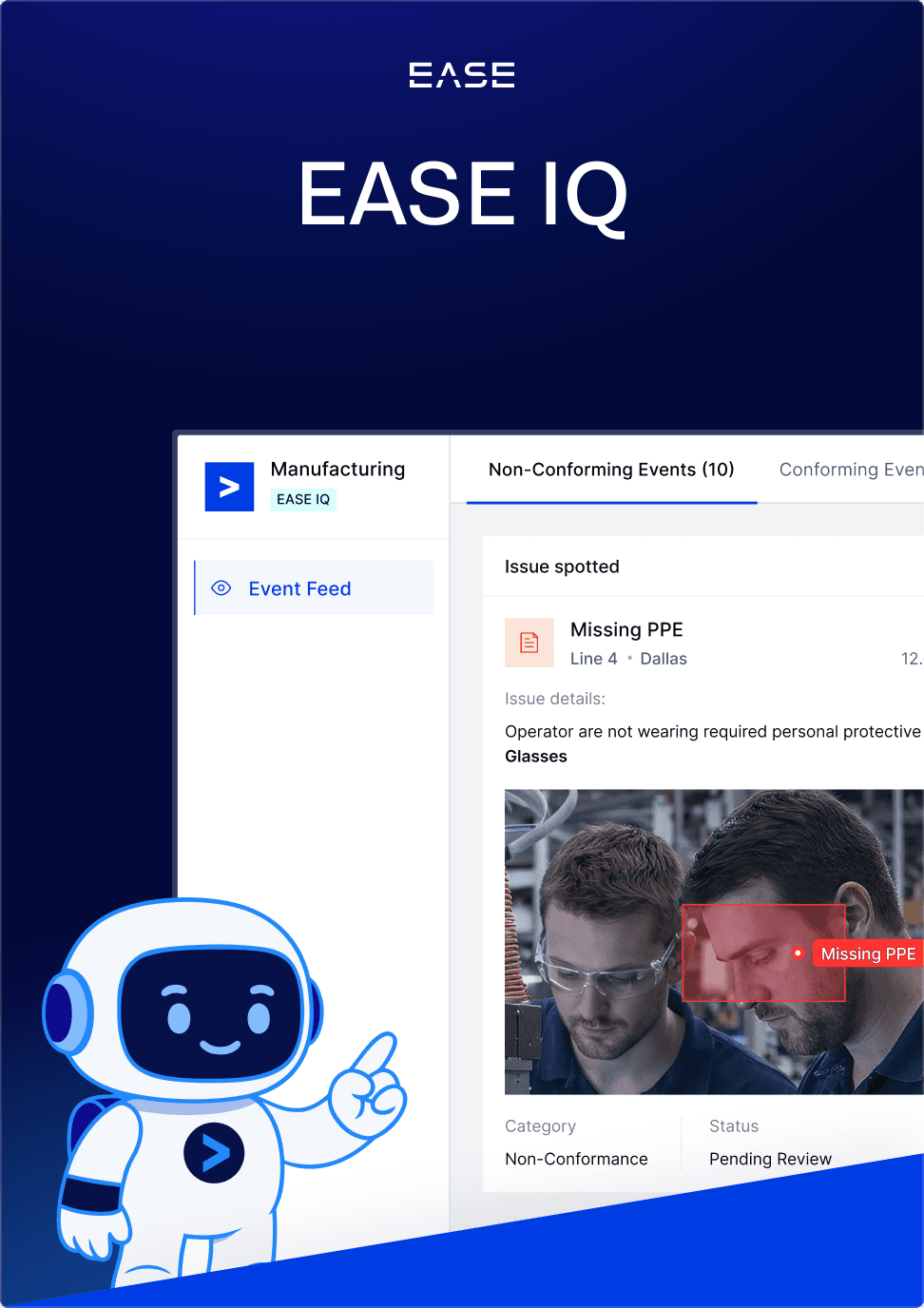
AI-powered assistants like EASE IQ Digital Workers also work alongside plant teams to monitor for defects and process non-conformances, routing issues automatically for follow-up. One EASE customer, for instance, reduced as many as 30 barcode mismatch escapes per year down to zero after implementing camera vision on their production line.
At Bosch Home Comfort Group, this approach has changed how teams handle inspections and safety:
“By combining computer vision with the EASE IQ Digital Worker Platform, we are now able to automatically detect PPE compliance, product inspection issues, and repeat non-conformances in real time. Instead of reacting after problems occur, our teams can prevent them on the spot. The result is a safer workplace, more consistent product quality, and a far more proactive way of managing inspections and compliance across our operations.”
Ultimately, getting value from AI doesn’t always start as a corporate-level strategy. It often starts with one person who owns a specific problem, has an interest in AI, and puts the two together. For quality leaders, the place to start is by asking which part of the process is consuming the most hours today.
Never miss a non-conformance again by putting EASE IQ AI-powered Digital Workers to work on your plant floor.