What is a Kaizen Board? A Guide to Continuous Improvement

Most plants say they’re focused on continuous improvement. On the production floor, it often looks different. The same issues appear in audits. The same conversations happen in meetings. Operators raise concerns, supervisors take notes, and nothing really changes.
The problem usually isn’t effort; it’s follow-through. Hitting production targets takes priority over improvement efforts, and ideas disappear before they even get off the ground. When improvement ideas disappear, people stop speaking up.
A Kaizen board changes that dynamic. Kaizen is a continuous improvement philosophy focused on making small, daily changes that improve processes, reduce waste, and strengthen performance over time.
The Kaizen board turns improvement from ideas into visible progress, proving that raising issues leads to action:
Issues become actions >> Actions get owners >> Progress becomes clear for all levels to see.
Here’s a scenario you might recognize: a packaging line keeps stopping because of a recurring sensor fault. Everyone talks about it, but nothing changes. The Kaizen board provides a visible place for the issue to be shared. From that point on, the issue moves on the board only when progress happens. Team members see it daily. Supervisors see trends. Leaders see the systemic gaps that need fixing.
What Is A Kaizen Board?
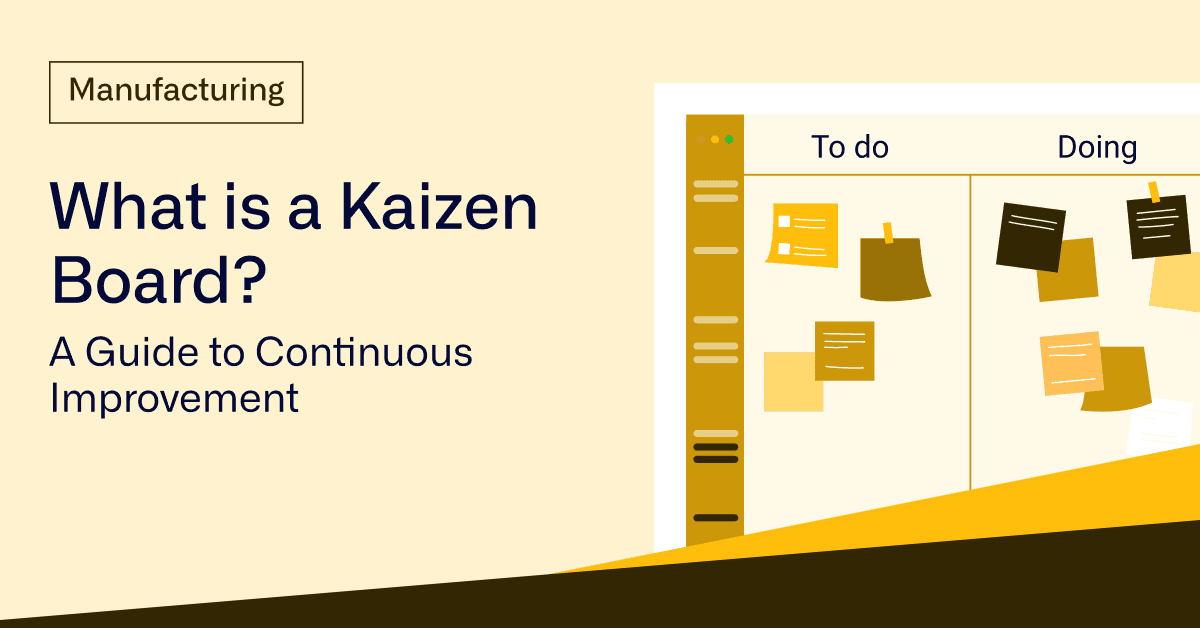
A Kaizen board is a visual management tool that organizes continuous improvement and structured problem solving in a simple, shared format. It creates a central place, be it physical or digital, where your team captures issues, evaluates root causes, and tracks work through defined workflow stages.
In this way, scattered improvement work turns into visible progress the entire team can see.
How Kaizen Boards Fit with Different Quality Methodologies
Kaizen boards reinforce several manufacturing methodologies:
| Methodology | What the Method Prioritizes | How a Kaizen Board Reinforces It |
| Kaizen | Daily continuous improvement, frontline engagement, small incremental changes that compound into major quality management and operational gains | Makes incremental progress visible in real time |
| Agile | Fast feedback loops, iteration, adaptable workflows, team ownership | Accelerates feedback loops and provides a forum for testing ideas and ensuring accountability |
| Lean | Reducing waste, stabilizing flow, delivering customer value efficiently | Makes sources of waste and delays easy to spot |
Kaizen vs. Kanban: How They Differ and When to Use Each
Kaizen and Kanban share roots in Lean but serve different purposes on the factory floor. Kaizen focuses on improving the work, while Kanban focuses on managing the work.
Kaizen drives continuous improvement by helping teams identify problems, test countermeasures, and strengthen processes. Kaizen boards often use Kanban-style columns, such as ideas/to-do, in progress, and complete, to track improvement work through clear workflow stages supported by Plan-Do-Check-Act.
But Kanban boards, by contrast, manage the flow of tasks or materials by visualizing work-in-progress and bottlenecks.
Benefits Of Using A Kaizen Board
Benefits of using a Kaizen board include:
- Enhanced visibility: Your team sees every active improvement effort at a glance. Continuous improvement becomes part of the daily routine.
- Increased accountability: Clear owners and deadlines help actions move quickly. Accountability becomes part of your Kaizen culture.
- Efficient problem solving: Structured problem solving and the Plan-Do-Check-Act approach prevent teams from jumping to solutions without understanding the root cause.
- Improved communication: Daily huddles, shift handoffs, and cross-functional discussions become smoother because everyone sees the same information.
- Employee empowerment: Operators often know where issues begin. Boards help them contribute to continuous improvement and feel ownership in the process.
- Data-driven decision making: Boards highlight recurring issues and trends. Leaders make decisions based on evidence, not anecdotes.
- Streamlined processes: Visible gaps lead to faster fixes, driving stability and supporting waste reduction across lines.
- Culture shift: If operators see their ideas disappear into a black hole, people stop speaking up and being engaged. A Kaizen board promotes a culture of quality by giving operators a voice and backing it up with action. When people see their ideas move forward, engagement grows.
- Cost reduction and customer satisfaction: Better processes reduce defects and downtime. Customers see fewer issues, and operations sees fewer surprises.
How To Implement A Kaizen Board
A successful Kaizen board requires clarity, consistency, and daily use. Here’s how to build one that supports continuous improvement without adding burden.
Choose the board type
These can be physical or digital and should be easily accessed by your team members.
Physical Kaizen boards, typically whiteboards or corkboards with sticky notes, are popular on the plant floor. They work well there because they’re visible where the work happens and easy to update without leaving the line. They support real-time discussion during shift handoffs and daily huddles.
Digital Kaizen boards are more common in offices or remote teams, where tracking history, sharing updates, and collaborating across locations matters more than physical proximity.
Define the column structure
Your workflow stages should be simple and reflect real work. From left to right, the basic columns are typically:
| Column Title | Purpose |
| Idea/To Do | Contains new improvement ideas that team members have suggested. |
| In Review | Ideas that are being evaluated for feasibility, priority, and impact. |
| In Progress | Ideas that have been approved and are currently being implemented. |
| Completed | Improvements that have been successfully implemented and documented. |
| Results/Impact | Shows the outcome of the implemented idea, e.g., time saved, waste reduced, quality improved. |
Display the right information
Depending on whether a physical or digital board is being used, improvement ideas are generally captured on a sticky note or digital card respectively, which should include:
- A brief description of the idea or problem
- Date submitted
- Person/team responsible
- Expected benefit or reason for the change
- Status updates
- Measurable results (if known)
This keeps continuous improvement tied to real operational data.
Focus on high-impact issues
Digital audits and inspections help teams focus Kaizen efforts on high-impact problems that affect safety, quality, downtime, or waste reduction so the board drives meaningful gains. High-risk issues can include:
- Recurring quality failures. Repeat findings from layered process audits signal systemic issues that require process changes.
- Assembly and calibration breakdowns. Ongoing nonconformance in critical steps, such as missed torque checks or out-of-calibration tools, indicates high risk to product integrity.
- Customer-driven defects. Complaints tied to repeat defects often trigger focused Kaizen efforts to eliminate root causes and prevent recurrence.
Assign tasks and responsibilities
Every step in the process needs a clear owner. This supports accountability and strengthens Kaizen culture.
Use structured problem solving
Document root cause analysis, evidence, and trials. Pair each improvement with Plan-Do-Check-Act steps to prevent guesswork and reinforce consistent continuous improvement.
Track progress and measure results
Use metrics that matter such as rework, machine downtime, or waste reduction. Teams stay engaged when they see results. With the metrics defined, verify improvements, and share before-and-after results. Closing the loop matters. When teams track ideas through to verification, the board becomes proof that their contributions lead to meaningful change. This keeps the team engaged in improvement after a specific issue has closed.
Real-Life Kaizen Board Implementation
Toyota’s West Virginia engine and transmission plant shows how a structured Kaizen board strengthens continuous improvement on the floor. Teams identified a recurring camshaft chatter issue that risked late-stage production shutdowns. They elevated the issue for deeper analysis and improvement. Through Kaizen, team members developed a simple, low-cost inspection tool that detects camshaft chatter earlier on.
Since implementing the improvement, the plant has avoided production line shutdowns tied to this problem.
The workflow followed a classic pattern:
- Document the problem
- Gather observations
- Perform root cause analysis
- Test countermeasures using Plan-Do-Check-Act
- Verify results
- Standardize.
Toyota’s example shows how small visible improvements can protect operational stability.
Common Challenges And Pitfalls With Kaizen Boards
Even well-intentioned Kaizen boards can stall if the process isn’t supported by consistent routines, clear ownership, and visible follow-through. Below are the issues manufacturing teams see most often, along with practical ways to keep your continuous improvement system healthy.
Low Frontline Engagement
What happens on the floor:
Most Kaizen boards don’t fail because of layout or tools. They fail when ideas stall. Once operators believe their idea will be ignored, participation drops.
Example:
A packout operator suggests adding a small tool rack to reduce walking. The idea sits untouched for three weeks and they never submit another idea.
How to overcome:
- Capture the idea on the board, using the Kaizen process to address it in a timely manner
- Showcase the win prominently, such as with a “Before/After” display on the board
- Recognize and thank the person who brought up the now-completed issue
The same issues surface repeatedly
What happens on the floor:
Many plants have Kaizen boards, audits, and training programs, but too often they operate separately, leading the same issues to resurface repeatedly.
Example:
On a machining line, layered process audits and supervisor walk-throughs repeatedly flag the same issue: torque checks on a critical fastener aren’t being performed consistently at final assembly.
How to overcome:
- Add the issue to the board with a clear owner and due date so owners address the issues, not just discuss them.
- Focus Kaizen work on the root cause of why the step is missed, such as tool access, unclear instructions, or time pressure, rather than reminding people.
- Use on-the-job training to communicate any updates to standard work.
- Use layered process audits to verify that the change holds.
- Update the Kaizen board with the results, such as a decrease in scrap, complaints, or reworked parts
The goal here isn’t a better board; it’s a system that makes the right behavior easier than the wrong one.
Difficulty sustaining the process over time
What happens on the floor:
Boards start strong but slowly fade. Shift leaders stop updating them, improvement huddles get skipped, and continuous improvement becomes optional.
Example:
The morning shift updates the board daily, but the night shift stops using it. Within weeks, the board is half-dead.
How to overcome:
- Add Kaizen board reviews to your daily Gemba walk checklist.
- Hold supervisors accountable for keeping their area board current.
- Post a monthly “Top 5 Completed Kaizens” summary.
- Set a simple expectation such as one idea per person per month, supported by supervisors.
- Reserve 10 minutes per shift for idea discussion
Final Thoughts
A Kaizen board creates the conditions for continuous improvement to happen. By making problems visible, clarifying ownership, and tracking progress through simple workflow stages, it turns good intentions into consistent action. Operators see that speaking up leads to change, leaders see trends instead of anecdotes, and teams follow through on problem solving. Continuous improvement becomes part of daily work as opposed to an abstract concept.
Over time, the discipline of Kaizen boards compounds, helping plants reduce waste, stabilize processes, and build a culture where continuous improvement and quality thrive.