Lean Is a Seed, Culture Is the Soil: What Many Manufacturers Get Wrong About CI
Episode overview
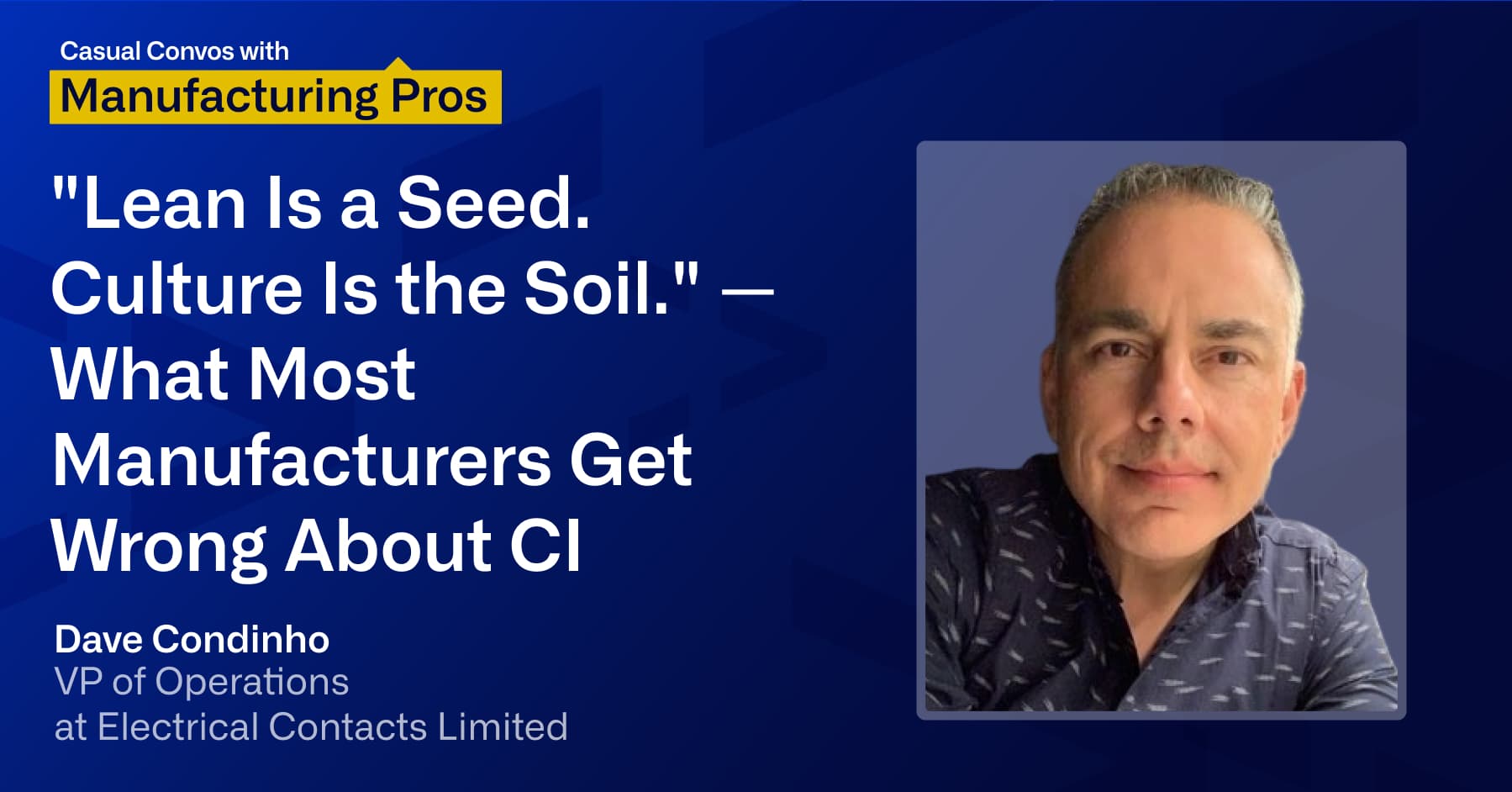
In this episode of the Shop Floor Top Floor Talk Show, host Josh Santo sits down with Dave Condinho, VP of Operations at Electrical Contacts Limited in Ontario, to unpack one of manufacturing’s most persistent problems: why continuous improvement initiatives so often fail to stick. Drawing on his Toyota roots and decades of operations leadership, Dave makes the case that lean tools like 5S, Kaizen, and standardized work only thrive when planted in the right soil: a culture built on respect for people, servant leadership, and daily discipline.
The conversation moves fluidly from the tactical to the philosophical. Dave walks through how he protects time for coaching moments through Leader Standard Work, how he uses “friction” on the shop floor as a diagnostic signal that something in the system is broken, and why finger pointing in meetings is his cue to redirect the team toward the real question: how did we fail to set this person up for success? He shares a candid story about a client who ignored his advice to fix the environment before implementing 5S, then called him back three months later admitting the initiative had unraveled.
The episode culminates in Dave’s introduction of the HEAL framework (Harness human potential, Elevate frontline leaders, Activate with skills, and Lead with alignment), a four pillar operating system he and his advisory team developed to help organizations sequence continuous improvement the right way. For any manufacturing leader who has watched a lean rollout fizzle after the consultants leave, this conversation offers a clear eyed diagnosis and a practical path forward.
Listen to the full episode here:
Transcript
[00:00:17] Josh Santo: Welcome to the Shop Floor Top Floor Talk Show, where we have casual conversations with manufacturing pros. Each episode digs into the challenges and opportunities for improvement that steer both frontline execution and big picture progress. No fluff, just real world practical perspectives from the people driving the industry forward, from the shop floor to the top floor.
[00:00:45] Josh Santo: Let’s get to the show.
[00:00:54] Josh Santo: Dave, thanks for joining us today.
[00:00:57] Dave Condinho: Josh, it’s a pleasure to be here.
[00:00:59] Josh Santo: It’s great to have you on. I know we originally got put in contact together by Bill Neavy, and he introduced us. Actually, I think you might have introduced me to Bill. This was back in the Conquering Chaos days.
[00:01:14] Dave Condinho: I remember that. Bill did a great job with that podcast back in the day, and he’s been a good friend of mine for quite a few years and he’s part of our advisory team for the Hill program.
[00:01:25] Josh Santo: I love talking with Bill. That’s with Lean Cycle Time, everyone that’s listening in. So Bill’s, Bill’s great. Well, I’m excited to have you. I remember back in the day when we were talking, you weren’t so sure about joining a podcast. That’s why you introduced me with a few others.
[00:01:39] Josh Santo: But finally gotcha to come onto the show. I’m curious, what changed your mind? What made now the time to join a podcast?
[00:01:49] Dave Condinho: Right. Well, we spent a lot of time working on finalizing the HEAL framework, which we did. That was a priority to me. And I thought once the HEAL framework was finalized and we’re ready to go live with it, which we are, you’d be the first one that I would consider, doing a podcast with, so.
[00:02:08] Josh Santo: Well, we’re gonna talk about that HEAL framework later on. But before we get to any of that, today we’re gonna be covering what manufacturers get wrong about continuous improvement, and we’re also gonna get into why the people side is the foundation that determines whether it sticks.
[00:02:26] Josh Santo: But before we really dive into those topics, we like to start every show… I know you’re familiar with this, Dave. We wanna understand what a day in the life is like. Now, I’m curious to ask you, you’re the vice president of operations at Electrical Contacts Limited in Ontario. What does a day in the life in your role look like?
[00:02:50] Dave Condinho: Well, it’s never the same from day to day, that’s for sure. Most days I wear multiple hats. My main responsibility is overseeing the daily execution of the operations. But the heart of my job is more about supporting people. And not just the people that report to me, but the cross-functional teams. So anyone that has any ideas that they wanna run by me, or if there’s any problems that they need help with, I try to make myself available. So generally I don’t pack too much into my schedule because I need to keep myself open for some of that unplanned conversations or coaching moments, because ultimately that’s where the real work happens.
[00:03:35] Josh Santo: So in your perspective, the real work is those unplanned conversations with the folks that you’re leading. Tell me more about that. How is that the real work when you’re responsible for the daily execution of operations?
[00:03:50] Dave Condinho: Right. So as leaders, our job is to continue to grow leaders and people. So I wanna always make sure that I have time set aside to take on some of those coaching moments. And even when we’re deep into the firefighting, I take that moment as an opportunity to coach people, right? Whether it’s performing problem-solving or root cause analysis, or just how to deal with people. I just wanna make sure that I’m always available to help them, right? That’s my priority in my role.
[00:04:22] Josh Santo: So the number one job from your perspective is growing leaders and people, and you said even in the midst of firefighting. I can’t tell you, Dave, how many people who’ve come onto the show when I ask them what a day in the life is like, and they talk about every day is different. We’re fighting fires.
[00:04:38] Josh Santo: Who knows what fire is gonna be happening today, whether it’s a customer complaint or a third-party auditor has showed up or, whatever just kinda interrupts whatever you’re expecting. And I love that you’re saying despite that, despite what could be chaotic, what could be stressful, you are committed to taking the time and protecting the time to have those conversations with people because it’s your job to grow and develop the future leaders. That can be difficult amidst that chaos. How do you protect that time?
[00:05:13] Dave Condinho: So I use a tool called Leader Standard Work, where you prioritize your daily tasks, but then you also have some availability in your day to tackle some of those unplanned conversations or firefighting moments because everyone goes through it. So I start off with what are the high level priorities every Monday. These are the things that I truly need to focus on. So I try to block out some time, and we use a thing at work called red time, which is essentially please do not disturb me because I’m heavily in focus time, planning time, or I need a break because the day’s been hectic and I just need a reset.
[00:05:54] Dave Condinho: So that’s what we use, and it just helps protect the time and then, you know, kinda separate ourselves from the daily noise.
[00:06:03] Josh Santo: Well, talk to us a little bit about what your leader standard work looks like at the VP of operations level.
[00:06:11] Dave Condinho: Yeah, so it’s making sure that everyone has what they need, for the day, for the week, to be effective in their role. And, you know, go through some high-level strategizing, reading of emails just to see what are the concerns for the day where people might need my support. So generally in a VP level, you don’t wanna be tied down too much with the daily tasks.
[00:06:37] Dave Condinho: So quite often, anywhere from 10 to 20% tops that you want standardized. The rest, you gotta leave it open because you gotta work with your people every day. There’s people coming in and out of the door nonstop, so you gotta be ready for that.
[00:06:53] Josh Santo: You mentioned the importance of having that time so that you can spend it on not only whatever may present itself, but those unplanned moments to provide that coaching and that development. I imagine that’s really, in some cases, you’re relying on your own experience and the frameworks that you’ve been exposed to, and the things that you’ve seen succeed and fail over time to have those conversations.
[00:07:15] Josh Santo: I’m curious if there’s a specific technique or way in which you’re approaching those unplanned growth and development moments with the team under your leadership.
[00:07:27] Dave Condinho: So back in my time at Toyota, they were really heavy on respect for people. So when you had a problem and you came to the manager and you were looking for an answer, you never got the answer. You got a question, right? They would often say, “Well, what do you think we should do here?” Right? Because a lot of times the people have the answers to the questions, but they just don’t have the confidence to do it, or they need that reassurance from leadership that, “Hey, you’re on the right track, you know, just go ahead and do it.”
[00:07:59] Dave Condinho: Right? So when I’m presented with those unplanned moments, I take the time to really collect all the facts, and if they haven’t brought the facts to me, that’s the first step. Please go get the facts and then come back to me. But then I start taking them through the, “Well, you know, you’re the process expert.
[00:08:17] Dave Condinho: What do you think here?” Right? And just give them that reassurance that they’re on the right track.
[00:08:22] Josh Santo: Hmm, okay. And is, you know, when you think about these conversations, are there certain groups within your facility that you’re having these conversations with, or is it anyone and everyone within the facility?
[00:08:36] Dave Condinho: Eh, it’s usually anyone and everyone. So, you know, whether it’s, quality, production, engineering, sometimes even the president will come in and say, “Hey, I need your thoughts on this. What do you think?” Right? So you gotta be open for any conversation from anyone.
[00:08:52] Josh Santo: Okay. So up and down the chain, doesn’t matter the hierarchy, the real way to develop people and have those unplanned moments is it has to be a willingness and a priority from the leadership to identify those opportunities to develop, to use tools like what you said, you know, where you respond with a question as opposed to providing an answer, teaching people to think or finding out if there is just a need for reassurance in supporting them in trusting their intuition, their expertise, their instinct.
[00:09:22] Josh Santo: There’s also, what I took away from that, Dave, is an element of humility. If the president of your organization, you know, someone that you’re reporting to comes out, and treating it as an opportunity to further develop them in a way.
[00:09:40] Dave Condinho: Yeah, exactly. And I, I’ve often, believed in a servant leadership type role, right? I’m not the expert of the operations, the people are. So I lean on them for their expertise. But what I do is help guide them to solve the problems themselves or support them in any way.
[00:10:01] Josh Santo: Now, I’d be willing to bet if I pressed you, you could probably answer a lot of the questions that come your way. What do you think?
[00:10:10] Dave Condinho: I could, but then I’d be defeating the purpose of growing leaders and people, right?
[00:10:15] Josh Santo: I bring that up because I can’t help but think of a very popular TV show, and I’m wondering if you’ve seen it. It’s called Ted Lasso.
[00:10:24] Dave Condinho: Yes. Yes. I haven’t, I haven’t seen the show myself, but I, I’ve seen bits and pieces of it.
[00:10:29] Josh Santo: Well, I bring it up, for anyone who’s seen the show, the reason I bring it up is because, Dave, what you’re describing is in a sense that character’s approach. You know, he’s put in this situation where has no experience, with anything to do with soccer or football, depending on where you’re from, and his whole mindset is exactly what you just described.
[00:10:51] Josh Santo: He’s good at being a coach. He’s good at developing people. He’s good at empowering them to be the best versions of themselves. They know what to do. They need a little bit of guidance, et cetera. And so I just can’t help but remark on that mindset, and how pop culture is, treating that currently.
[00:11:07] Dave Condinho: I currently go through that myself. I am the acting engineering manager, so by trade I don’t have any engineering experience. But, the president knew that I just have a way of working with people that that’s what they need right now, is just someone that can lean on their expertise, guide them in the systems thinking. But, they’re the experts. They know how to do all the calculations and the formulas and, the product development side of things. But I’m just there as a support for them to ensure they have what they need to succeed.
[00:11:42] Josh Santo: So you have recently been put in a situation where you’ve been asked to take on this responsibility that you admittedly are like, “I’m not an engineer by trade. I don’t know their role.” But what you do know is that leadership, that development of people, and how that can enable a team to come together to accomplish what the goal is.
[00:12:04] Josh Santo: Can you talk to us a little bit about how you took on that responsibility? What did you institute or change that really drove some of the things that we’re talking about here?
[00:12:18] Dave Condinho: Right. So the first thing I look at is I try to get as much as I can into their reality. What are they dealing with today? And I’m a systems guy, so I look deep into the systems and did we set up systems to help them with their day-to-day activities, or do we have broken systems that might be impacting, their performance?
[00:12:41] Dave Condinho: So the first thing I do is get talking with them, get to know a bit more about their role and what their expertise is, and then I start diving into the systems and to see what I can do to support with that. And again, leave the actual work to the experts, and myself just do what I can to ensure that they feel supported.
[00:13:03] Josh Santo: When you say systems, talk to us about what you mean when you say system.
[00:13:08] Dave Condinho: Yeah, so in engineering, you’d be looking at your product development, through your phase gates, ensure that, they have what they need to go through each phase, whether it be, documentation support or even just, certain processes where they might be stuck in a particular phase, and they can’t seem to get out of it. So, I look at well, what can we do differently to ensure that there’s a smooth transition from gate to gate? And, you know, the document change notice is another area that falls heavily in the engineering group because a lot of the changes that happen in the manufacturing fall into the engineering world.
[00:13:48] Dave Condinho: So we wanna make sure that there’s good workflows, and the less people feel stalled, the less frustrated they’re gonna be. So just whatever I can do to help in that.
[00:14:02] Josh Santo: So you’re searching for friction and you’re finding what’s either the source of that friction or what can smooth that out and ultimately create, a little bit better flow with, with the process or the way that they get involved.
[00:14:15] Dave Condinho: Mm-hmm. Yeah, and usually when you see the friction, that’s a clear sign that something’s wrong with the system, right?
[00:14:24] Josh Santo: Interesting. Friction as a clear sign that something’s wrong with the system. When we think of friction, is there a specific definition that you would bring to that so that if people looked around and they saw blank, that’s a clear sign that something’s wrong?
[00:14:43] Dave Condinho: Yeah. I look at production operators, for instance. So if I’m walking the floor and I see an employee’s frustrated doing a process, I just come up to them and ask them, you know, “What’s happening here? Why… You seem upset. What’s going on?” “Well, this isn’t working right,” or, “No one ever trained me on this part of the process.”
[00:15:05] Dave Condinho: So that tells me that there’s, a gap within our system, our training program. So that’s where when I say you can tell that there’s a problem with the system through friction, you gotta be able to go to the gemba, which is what I always say. Go see what’s going on. Talk to the people because, they’re the ones that are gonna point you to where the root cause of their friction is.
[00:15:30] Josh Santo: Now, it can’t be stated enough. Go to Gemba, see, check in, what’s going on. I like that, you know, when you first mentioned friction, I was thinking maybe like slowdowns or delays within workflow, thinking like, you know, “I did this thing. This person’s supposed to take over. I haven’t gotten an update from them.”
[00:15:49] Josh Santo: And then you find out like, well, they didn’t get an update from someone else and… But you kind of brought an emotional element to it, going there and observing this person is clearly frustrated, and that in itself is a type of friction within your overall operation. So checking in, “What’s got you frustrated?
[00:16:06] Josh Santo: What can I do?” Hearing them out, getting to whatever the drivers are, the root cause, and then taking some sort of action.
[00:16:17] Dave Condinho: Yeah, and you just mentioned one of them, the communication breakdown. You see it a lot, right?
[00:16:20] Josh Santo: Yeah.
[00:16:20] Dave Condinho: Like the telephone game. You hear something that you need to do, and you pass it on to the next person, and it slowly starts losing its context. And, the last person’s totally frustrated ’cause they have no idea what’s going on.
[00:16:33] Josh Santo: Yeah. You see that all the time. We see that here at EASE for sure. You know, anytime we’re talking about, moving from more analog systems, systems of record, and moving into a digital experience, that’s really one of the big things right there is there’s so much information that just stalls in silos, and then you can’t capitalize on it, and it’s another point of friction that can lead to frustration, among other things.
[00:16:56] Dave Condinho: Mm-hmm.
[00:16:57] Josh Santo: Dave, you mentioned your approach to leadership being a servant leadership approach. One of the questions I had when you said that was, did you have a leader that really encompassed this idea that you have now of leadership? And if so, who were they? Talk to us about how they impacted you.
[00:17:17] Dave Condinho: Yeah, I would have to say my experience at Toyota was where I truly adopted that servant leadership, quality. So I had a manager that would often come to me, and he would start asking for my opinions and, “Hey, what do you think of this?” You know, ” if we needed to reduce the cycle times, you know, do you have any ideas about that?” And it just… The leaders that I had before that were often, you know, “Here’s what we’re doing,” even though I’d been doing the operation for years, right? Never asked my opinion. But here I saw a different side of it where it’s, you know, this guy’s in leadership. He’s been there for 20 years, and he’s coming to ask an employee that’s been here for maybe two years, “What do you think?” So I really appreciated that characteristic of a servant leader, and I really took that and molded it into my leadership style.
[00:18:14] Josh Santo: Why do you think that resonated with you so much?
[00:18:18] Dave Condinho: I think every employee wants to feel valued. They wanna feel like they’re being heard. Every employee has great ideas, and as leaders, if we’re not tapping into those ideas, then those are opportunities lost, right? So it’s our job to have the conversations daily. So when we do our Gemba walks, as leaders, we should be out on the floor and just asking questions, you know, like, “How’s your day going?” Right? Are you good with this process? Do you have any ideas how we could improve? Right? “And if you do, you know, submit a suggestion and we’ll put you on the team and we’ll make some positive changes.”
[00:19:01] Josh Santo: Well, Dave, you hit on a key word. You said improve, and that is absolutely an area that I wanna dig into because, you know, in manufacturing, one of the big things is improving continuously. I wanna talk about your experience with continuous improvement. What have you seen manufacturers get wrong about continuous improvement?
[00:19:24] Dave Condinho: I would have to say that continuous improvement works in every situation. In my experience, it doesn’t. And what I mean by that is you have to ensure that you have the right environment for continuous improvement to thrive. So, when people talk about what’s the best way to implement Lean? I always tell them, start with the environment. The way I explain it is Lean is like a seed, and in order for it to grow, you have to ensure that you have the right soil or the right environment, otherwise it won’t thrive. And that soil could be having the right culture, such as the people feel like they’re being heard, you’re not consistently in firefighting mode because you don’t have standardized work. And, when people try to implement tools like 5S or Kaizen, they often just go straight to the tools ’cause they want those quick wins. I had a client once come up to me and ask me to, support him in implementing 5S. So when we did an assessment, I uncovered that the environment just wasn’t the right environment for 5S to flourish. So when I handed the assessment to him, I said, “You know, I’ll be honest, I don’t think it’s gonna work here until you, improve the environment first.” But they still wanted to go ahead and, you know, as a consultant, you just go with what your client wants, even though you know that it’s probably not gonna work.
[00:21:03] Dave Condinho: So soon enough, we implemented 5S, and then within, I think three to four months later, I got a phone call and they were telling me, “You know what? I think you were right,” because we’re right back to where we started. So that’s why I always say it’s important to look at the environment to which you’re gonna implement continuous improvement. Work on that first so that the conditions are perfect for it to thrive, otherwise the tools won’t stick.
[00:21:34] Josh Santo: So continuous improvement does not work in every situation. You need to have the right environment. You mentioned that if you consider lean as an example, lean would be a seed, something that you plant and then grows and takes off. But in order for it to grow, it has to have the right soil, which you defined as culture, as people being heard, as, not being in firefighting mode because there’s standardized work.
[00:22:01] Josh Santo: Often people tend to associate the concepts of continuous improvement with specific tools. You mentioned 5S as an example. So we’re going to do 5S, and that’s gonna let us improve continuously versus, treating all of this stuff as framework that has to be applied in different scenarios, in different ways, tools being different manifestations of how that can come together and enact some sort of discipline.
[00:22:29] Josh Santo: Ultimately, there’s a need to assess your own situation as well as customize the implementation to your own specific needs. You brought up a great example of having a conversation with a client where you noticed after an assessment that the environment was not ripe for a continuous improvement initiative for 5S, as an example.
[00:22:52] Josh Santo: You know, without, necessarily getting into specifics, I’d love to hear some examples of what you observed about that environment and how you assessed it in order to come to the conclusion that they needed to do some work on their environment first.
[00:23:08] Dave Condinho: Well, that’s where the Gemba Walks come in. So you get the permission first to talk to the people because they’re the ones that are gonna tell you the truth, right? Leadership’s not gonna tell you they got a culture problem, but the people would be the first ones to tell you. So you start asking the questions and, you know, have you received proper training for the process that you’re currently operating today? Do you feel engaged in con- continuous improvement or even working on the strategy with leadership? Do leadership come to you with, requests for ideas on how to improve the processes? So if you don’t see engagement with the people, if the people feel disconnected from the organization, then you know you’ve got a silo situation between people and management. And often the people are gonna feel like, “Oh, this is another flavor of the week by management here,” and therefore they’re not gonna be bought into it. So it’s important that they’re part of the, solution, not just, you know, passing down, “Here’s what we’re doing whether you like it or not.”
[00:24:17] Josh Santo: Hmm. And why is that?
[00:24:20] Dave Condinho: To me, again, it’s going back to that servant-type leadership style, right? So in our organization, when we’re working on strategy, we bring in the people, right? So we’re like, “Here’s, where we wanna go. How do you guys think we can get there?” Instead of saying, “This is how we’re gonna get there,” right?
[00:24:39] Dave Condinho: ‘Cause they might have some ideas that we haven’t thought about because they’re on the floor. They know what it is that they’re dealing with on a day-to-day basis. So there might be, things that you have to address first before you can really dive deep into, a strategy. So when you ask people for their opinions, what do they think, right, about a situation, you immediately get that buy-in.
[00:25:06] Dave Condinho: It’s kinda like that situation I had talked to you about, I had from Toyota. So when I saw that kind of leadership style, to me, it made me feel valued, and my voice matters in this organization.
[00:25:21] Josh Santo: There’s an element here that I think that’s worth getting into, this idea of soliciting feedback from folks or ideas on how do we accomplish the goal that’s been set. There’s also, at the end of the day, when you work for a company or an organization, there’s things that have to get done, and you really can’t avoid scenarios where someone makes a call and says, “Do this.”
[00:25:52] Josh Santo: How do you balance what you’re describing, which is this enabling let’s build it together with this there are things that gotta get done, and it might even suck to do them, but they gotta get done right now. Get them done. How do you balance that?
[00:26:10] Dave Condinho (Ad-Vice): Hi, I’m Dave Condito. I’m the Vice President of Operations for Electrical Contacts Limited. My advice to you is invest in your people every single day, not just quarterly, but daily. And the reason for that is you wanna build the right environment within your organization for things like lean to thrive.
[00:26:31] The culture is the important piece, and I refer to it as the soil, and lean is like a seed. So if you want lean to grow in your organization, you gotta work on the environment. So focus on your people. Leaders, you need to be on the shop floor every day. Talk to your people. Ask them questions. You know, get their advice.
[00:26:53] You wanna break down those walls because that’s where you get the respect from the people, and it’ll become easier for you to continue to get the results you’re looking for on the shop floor
[00:27:04] Mid Roll – Review Section: All right, quick pause before we jump back in. Like you here on the Shop Floor, Top Floor Talk Show, we believe in continuous improvement. You don’t wait for an annual audit to fix what’s broken. You make small adjustments every day to get better. And this show works the same way, but the only way to improve is if we hear from the people that are actually doing the work.
[00:27:28] Mid Roll – Review Section: So if this episode has helped in any way, maybe it sparked an idea. Saved you from a mistake or even just gave you a knowing laugh. Please do us a favor right now. Wherever you’re listening, tap the rating button or leave a quick review. It takes less time than a toolbox talk, and it helps other manufacturing leaders find conversations like this.
[00:27:49] Mid Roll – Review Section: Think of it as leaving a note for the next shift. Now we read every review and we use them and we genuinely appreciate you being a part of the Shop Floor, Top Floor Talk Show community. Alright, now that’s all I had to say. Let’s get back to the conversation.
[00:28:07] Dave Condinho: Yeah, and those situations are gonna come up. And again, if you’ve worked on that environment ahead of time, and you’ve broken down the wall between the employees and management… For me, when I was an employee and, I felt like I was being respected by management, they could have told me anything.
[00:28:27] Dave Condinho: You know, “I need you to stop what you do and work here,” and I would’ve respected that because I felt like I was being heard. I felt like I was part of the company’s solution to realize the strategy. So those things are gonna come up. The ones that generally push back are the ones that, you’re gonna struggle a little bit with getting buy-in no matter what you do. But not to say that they’re lost causes, but sometimes they do come around. But ultimately, there needs to be respect on both sides. So while leadership needs to respect the people, the people also need to respect leadership. And I know for myself, when I was on the floor, there were moments where I didn’t respect the leadership.
[00:29:09] Dave Condinho: I thought, “Oh, what are they doing up there?” “They have no idea what it’s like down here.” But it wasn’t until I got in a leadership role where I realized, wow, this is what they were going through. And I actually made a phone call to an old manager at Toyota and I said, “Look, I’m sorry if I made you feel like I hated you, but I have the uttermost respect for you because now I truly understand what you had to go through.”
[00:29:38] Josh Santo: Looking back on that example and thinking about how you had that sort of, you know, “What are these guys doing? They don’t know as much as I do about this thing. This is the way we should be doing X, Y, and Z.” Looking back on your interaction with your leadership at the time, do you think there was something they could have communicated to you that would’ve changed your mindset there?
[00:30:03] Dave Condinho: I think they could have, but I mean, we all go through those stressful moments where the production line’s behind and everyone’s pushed to make sure they get the numbers before the end of the shift. So sometimes, managers… I’m not perfect myself either. You know, I might have those moments where you’ve just got the weight of the world on your shoulders as a leader, and you gotta push your people, right?
[00:30:27] Dave Condinho: And sometimes they’re not gonna like that, right? They don’t like to be pushed too much. But again, at the end of the day, it’s just recognizing, you know, this was the stress of the day. It’s good. You know, we’re cool here. We can move forward, right?
[00:30:42] Josh Santo: Yeah. It’s okay if there’s maybe some short-term not ideal scenarios, as long as you are making progress to turn it into, over the long term, the more sustainable, the more ideal way of doing things. So maybe accepting some compromise in the moment while you drive towards something that’s gonna be better for the future.
[00:31:08] Josh Santo: Well, when you talked about this idea that you need to have the right environment, and you talked about lean being a seed as an example, and soil, being what helps grow and nurture that, you mentioned the word culture. I’d love it if you could define culture for us.
[00:31:29] Dave Condinho: Well, as we often say, the way to define culture is, is the things that we do every day when leadership’s not watching, right? If I was in an environment in a new company and I didn’t know the people, the first thing I would look at when leadership went to the floor is did the behavior change of the people when they came on the floor?
[00:31:52] Dave Condinho: Are they nervous? Are they scared? That helps you to understand a little bit of the friction that’s there with the people and the leaders. But if you’re in a good environment where people believe in the values of the organization, and it’s not just, wallpaper on the wall or something, but it’s lived in daily, right?
[00:32:15] Dave Condinho: So if leadership comes to the floor and people are still performing the way, that they normally would even if they weren’t there, then you know the culture’s pretty solid, right?
[00:32:27] Josh Santo: So when you as a leader go to Gemba to observe, if you do notice that all of a sudden people are maybe, paying deeper attention to a specific thing or maybe keeping their station clear of unnecessary tools or debris or anything like that, but the second that you leave the floor, maybe everyone relaxes and kinda regresses a little bit, that is an indication of the type of culture that you have, and it’s not the one in which this continuous improvement is gonna thrive, ’cause you’re not really sustaining habits at that point.
[00:33:08] Dave Condinho: Right. Yeah, and it’s like we run 24/7, so if we’ve got 5S standards that need to be achieved at the last 15 minutes of the shift, you know, the indicator that you have good culture is when the night shift rolls around and there’s no leadership there, right? They’re still doing the things that they need to do because they’ve bought into it and they feel valued, and they know that it helps the next shift achieve success.
[00:33:41] Josh Santo: Yeah. Let’s talk about the impact culture has on continuous improvement, ’cause that’s helping the organization achieve success. So from your perspective, what impact does culture have on continuous improvement?
[00:33:54] Dave Condinho: Again, it’s huge. We’re talking about the soil there. So we want continuous improvement to thrive throughout the organization, and we want it to be the mindset that people are doing, you know, without even thinking about it. If you have the right environment where we’re practicing continuous improvement daily, people feel bought into the vision, the tools, you know, then things are gonna thrive.
[00:34:22] Josh Santo: And it sounds like they’re gonna thrive because they’re gonna be sustained. I think that’s one of my takeaways from what you’re sharing, is that you could implement all these initiatives and you can be there telling people they need to do things this way, but the second that you’re not there, if that isn’t sustained, then you didn’t really achieve an improvement.
[00:34:43] Josh Santo: It’s almost to your point or in that example that you provided where the client of yours implemented 5S, three or four months down the road, “Hey, we need to talk again because this thing didn’t have the impact that we were expecting.” And when you break it down, it’s because it wasn’t sustained because the environment, the culture wasn’t there.
[00:35:05] Dave Condinho: Exactly.
[00:35:06] Josh Santo: Well, how do you build that kind of culture?
[00:35:13] Dave Condinho: You build it with daily practice, right? It can’t be a one-time initiative where, “Everyone, we’re gonna have a team building exercise today, and we’re gonna have great culture, and everyone’s gonna feel valued, and away we go.” And then we never do anything again for the next three months, right?
[00:35:32] Dave Condinho: That’s just business as usual. But if you wanna develop those neural pathways, it’s gotta be a daily practice, right? So leadership needs to walk the floor. They need to talk to the people. They need to engage people. And if it’s not part of your leader standard work as a leader, it needs to be because you get results through people.
[00:35:53] Dave Condinho: And if they feel disengaged, then things are just gonna fall apart.
[00:35:58] Josh Santo: Get results through people. I think that’s the theme of the entire episode. You, need to have that buy-in and, that adoption from them to sustain whatever it is the initiative is gonna be. So I think you just summed up just about everything that we talked about. You get results through people.
[00:36:15] Josh Santo: And by the way, that’s, you get positive results, and you also get the not so positive results through people. But there’s only one path to results, and that’s through people.
[00:36:26] Dave Condinho: Even recognizing that those not so positive results, there’s always some learnings there, right?
[00:36:32] Josh Santo: Yeah, absolutely. When I hear you say daily practice, the word that comes to my mind is discipline. You gotta know what needs to get done, and in this case, the example you’re providing is leader standard work in which part of your standard work as a leader is checking in with the people, identifying what’s driving friction, connecting with them, soliciting their perspective on how to improve that source of friction, and enabling them that way.
[00:37:05] Josh Santo: And then back to the point that you raised at the start of this conversation, protecting that time so that no matter what else is happening around you, you are still getting that done. So really what I’m hearing, Dave, is to address culture, to develop and nurture the culture that’s going to enable you as an organization to get the results that you wanna get.
[00:37:29] Josh Santo: You gotta have discipline.
[00:37:32] Dave Condinho: Exactly. And you need to have that we call it kata, but it’s the daily routines, right? And the more you do it, the more it just gets embedded into those neural pathways, and it becomes part of your leader standard work. And in my mind, it becomes the most important thing you can do in the day.
[00:37:53] Josh Santo: Well, we’re talking about culture. We’ve gone over what are things that you can look at to get a sense, a gauge on your own culture. From your experience, Dave, what’s a common misconception about culture that you’ve seen or that you’ve heard from other manufacturing leaders?
[00:38:12] Dave Condinho: The common one that I hear is that it’s a management vision, right? Culture needs to belong to everyone. leaders often try to define the culture, but really people need to be a part of that definition, right? What is the culture that they wanna work in? And as an organization, you need to work together to build that into the organization, right?
[00:38:38] Dave Condinho: It cannot be strictly a management vision of, “Hey, we need better culture. Here’s what we’re gonna do.” It’s, people, if you could work at the best organization you could work at, what would the culture be like? If you could kind of rip the roof off our organization five years from now, what do you see?” Right? So that’s the environment that people wanna work in, and that’s the environment, again, that we spoke about where continuous improvement’s gonna thrive.
[00:39:08] Josh Santo: So everyone is an owner of culture in that sense. Interesting. I think that, that is probably something that’s not always thought about ’cause, you know, the way that you described it, culture as a management vision, meaning kinda to the example that you provided, those guys over there came up with this thing, and now they want me to do whatever it is they’re asking me to do, as opposed to let’s rally together.
[00:39:36] Josh Santo: Here’s the type of environment that we wanna have. Let’s work together. We’re committed to you. We need you to commit to us. And now it’s a, it’s an us conversation versus, like a me versus you kinda thing.
[00:39:49] Dave Condinho: Right. And as leaders, we have to look in the mirror. Are we practicing what we’re preaching here as an organization? And if we’re not, we need to adjust.
[00:40:00] Josh Santo: I wanna talk, ’cause you brought this up earlier, the concept of lean. So I wanna get specific and talk a little bit about lean
[00:40:07] Josh Santo: Lean is often thought of as a way to improve, like a discipline, a framework that you implement so that you can drive continuous improvement. From your perspective, what is lean actually meant to do for a manufacturer?
[00:40:27] Dave Condinho: My perspective, it’s meant to help organizations solve problems by developing people, right? When you look at the Toyota Production System and everything that they do within the tools, it’s all about developing people. And that’s how the tools thrive. the tools aren’t just something you plug in and you gotta follow a list all the time, but it’s, it’s how do I develop people through problem-solving?
[00:40:56] Dave Condinho: How do I develop people through sustainment of 5S? So you always have to look at the people side of things, right? And that’s what has made Toyota, such a successful organization because they do this, without even thinking about it, right? It’s all about how do I develop someone in this situation?
[00:41:16] Josh Santo: I like how you’re essentially putting the person as the North Star of Lean. Lean is not about improving your organization. Lean is about developing your people so that they can solve problems. And then as the problems pop up in your facility, they’re well-equipped to address them, tackle those problems, fix those problems, improve as a result of having addressed those problems, and then you do that day in, day out, every single day, every week, every month, every year.
[00:41:50] Josh Santo: Well, now you’re improving continuously.
[00:41:53] Dave Condinho: Exactly. And as a consultant, I would say, I wanna develop lean champions in your organization because they’re gonna be the ones that are gonna continue to do this long after I leave.
[00:42:08] Josh Santo: I like how you also brought up the tools like, like problem-solving tools, 5S, as a way not only of working a problem or sustaining any sort of improvement, but you brought them up as specific examples as ways of developing people to solve those problems. How do those tools develop people?
[00:42:31] Dave Condinho: Right. Well, it helps develop discipline in the people, right? So when you look at 5S, making sure that the tools are back in the right spot and everything is set up properly for the next shift to come in and continue basically without any disruptions through the day. So, for some people it might not be part of their normal routines in life, but as you… I know for myself, after I left Toyota, the whole 5S thing even translated into what I do at home, right? How do I keep my office clean? How do I keep the garage clean? Which sometimes gets a little messy, I’ll admit. But when I look back at it, it was like, “Hey, that was a development opportunity,” because, I didn’t have to look at a checklist. It’s embedded into my brain now, and I just do it wherever I go.
[00:43:27] Josh Santo: Man, I can really relate to you on these principles and these concepts making their way into your personal life. Every time, after work and I’m finally gonna relax and maybe watch some TV, I’m like, “Where is the remote? Why is the remote not in its place?”
[00:43:44] Josh Santo: Clearly I have a culture problem here in my own house, and I’m probably the greatest contributor to the lack of discipline in that case.
[00:43:55] Josh Santo: Let’s say, put yourself in the position of a plant manager, which is, certainly probably not hard for you to do. But let’s say I’m a plant manager. I’m walking my floor. I’m looking around. What are signs that tell me that there’s something deeper broken that I need to address with regard to my culture and my environment?
[00:44:17] Dave Condinho: As I often say, the floor tells you the truth. And that’s why if I’m sitting in a meeting and I hear assumptions of what’s actually happening, I’m gonna tell someone, “Stop the meeting. Go to the Gemba.” Right? Don’t, don’t give me your assumptions, give me the facts. So if I’m a manager and I’m walking the floor, I’m seeing what’s actually happening on the shop floor, the truth, right? So if I see that people are disengaged or people look confused, that tells me that, there, there’s a problem with, the system, right? Whether it be how the supervisors set them up for the day, or maybe there was a communication breakdown or something. It’s looking for those behaviors in your people, and if, you know, you’re dealing with things like poor on time delivery, high scrap, constant firefighting, again, the… Those are the things that signal to me that there’s, there’s a problem with the system. So, we keep track through KPIs in every organization. You know, you look at the KPIs and like, “Oh, this doesn’t look good.” But when, when those KPIs come out, it’s too late, right? The damage has been done. But as a plant manager, it’s important to be out there daily so that you can fix the issues before they become a bad mark on your KPI.
[00:45:41] Josh Santo: And really, you wanna get ahead of that by going there, observing, finding these points of friction, and just helping to alleviate whatever’s driving that.
[00:45:50] Dave Condinho: Exactly. And if you see employees struggling, confused, that might signal to me that perhaps there’s a problem with the way they were trained right?
[00:46:01] Josh Santo: I like how you’re looking at it from a systems perspective, because at no point have you jumped to an assumption of there’s something wrong with this person. This person isn’t doing what we ask them to do. Rather, you’re taking approach of like something here is failing us right now and it’s failing this individual and they’re feeling it the most.
[00:46:26] Josh Santo: What is broken that we need to fix? And that seems like such a stronger perspective because there is something that you can do about it. Instead of saying it’s their problem, they need to deal with it, you’re saying it’s our problem, we need to help with that.
[00:46:44] Dave Condinho: When I hear those, finger-pointing, moments in a meeting, I just stop people right there and say, “Whoa.” How do you know it was that person’s problem? Maybe we didn’t set them up for success. So instead of pointing the finger, what can we do to help that person?
[00:47:02] Dave Condinho: That’s the mindset that I push.
[00:47:05] Josh Santo: I love that. At the start of the show, you mentioned something called the HEAL framework. Let’s talk about HEAL. What is it, and how does it answer a lot of what we just talked about?
[00:47:19] Dave Condinho: Well, The HEAL framework is an operating system basically for leaders, and it runs off of four pillars: harnessing the potential of the human potential, elevate your frontline leaders, activate with skills, and lead with alignment. So it’s built to address exactly what we’ve been talking about all throughout the show, right?
[00:47:41] Dave Condinho: The people side of things. So most organizations will jump straight into tools, projects, but HEAL forces you to start at the foundation, right? And you begin by understanding your people. You start building capabilities, creating the right environment for them that we had mentioned. And then you have to kind of follow it in the sequence, right?
[00:48:04] Dave Condinho: And that’s where you end up with the culture where improvement becomes a habit.
[00:48:09] Josh Santo: Let’s get a little deeper into each of those. So just as a quick recap, HEAL, H-E-A-L. H is for harnessing human potential, E is for elevate frontline leaders, A is for activate with skills, and L is lead with alignment. When you say harnessing human potential, what exactly does that look like?
[00:48:32] Dave Condinho: Well, for us, we start right at the time of recruitment. So what are the type of people that we’re looking to recruit in our organization? We wanna make sure that we hire people that are gonna fit into the culture that we’re working so hard to develop. And once we’ve hired these people, right, how do we onboard them?
[00:48:50] Dave Condinho: Are we giving them the tools they need to succeed the moment they hit the floor, right? On-the-job training. Are the team leads giving them, the proper training through TWI job instruction so that they have a great understanding of how to do the job, why they do the things they do, and the reasons for it, right?
[00:49:11] Dave Condinho: So it’s very important that we kick things off with harnessing the potential of people. And for us, we’re a people development organization. What I mean by that is we have a wage model. We’re constantly looking at growing the skills of our people internally, and in the process, we’re rewarding them for the skills they obtain.
[00:49:34] Dave Condinho: So the more they learn, the more they earn. That’s our model at, ECL, and it’s been very positive for our people. And of course, from there, I think anyone out there that’s been a supervisor can, admit to this. How many supervisors out there got the training they needed to be successful leaders and in managing people? I’m gonna guess that it’s a very small percentage. So we wanna ensure that people that are moving into those type of roles have the training they need to lead effectively and, and get those results through people. And once that they, they’ve got the, skillsets they need to lead with people, well, now we’ve got the environment where we can start giving them the skills, and we start teaching them Lean.
[00:50:23] Dave Condinho: We start teaching them the core quality tools, and the reason for quality at the source mindsets and Lean thinking mindsets. We’re growing their skills. And then of course, the lead with alignment piece is leadership ensures that the first three pillars are running successfully. So it’s that constant plan, do, check, act that’s happening within the organization and, it’s been great. We’ve implemented it even at Electrical Contacts Limited, and it is just helping us each day to continue to thrive to be the best at what we do.
[00:50:57] Josh Santo: What I appreciate about how you broke down that framework was not just the fact that you’re providing definitions and examples of those definitions being put into place, but you’re also talking through what are your own tools that you implemented to support the continued commitment, the discipline to chasing this ideal of HEAL.
[00:51:20] Josh Santo: So the example of harnessing human potential, you described everything from what you’re really looking for in the hiring process to what you can do to make sure that they have the foundational elements needed to really start to succeed in their role, and then from there, take it, make it their own, drive it, in any sort of way.
[00:51:42] Josh Santo: And the example you provided about the more you learn, the more you earn. So you’re finding a way to incentivize the behaviors, and patterns that you want as a part of this. So I think that’s one of the most powerful things that you just described is that there’s this ideal, and the framework is there to help you break that ideal into categories that you can chase.
[00:52:01] Josh Santo: And within those categories, each one has its own set of goals, and you probably over the course of years figured out different things that you could put into place that helped continue the commitment to trying to achieve those particular goals.
[00:52:19] Dave Condinho: Exactly. And really any organization can implement those pillars, but it’s not a one size fits all in its current state, but it’s the pillars that guide the continuous improvement within an organization at all four stages.
[00:52:36] Josh Santo: Well, one last question for you, Dave. Talk to us about Lean4Gain. You’re the founder of Lean4Gain. What is it?
[00:52:46] Dave Condinho: Lean for Gain is a global company that focuses on supporting organizations through the HEAL framework. Our primary focus is our own, Ontario, provincial, companies, as well as the rest of Canada. We’ve got advisors that are experts in each one of the four pillars, and they bring a unique skill set that really complements the HEAL framework. They’ve learned throughout the years what works, what doesn’t work, and we’ve really worked hard as a team to put this framework together.
[00:53:22] Dave Condinho: And now we’re at a position where we wanna share it with the rest of the world. And given the current state of the country now is a better time than none to take that first step and start to heal your organization.
[00:53:37] Josh Santo: Well, I love it, Dave. We’ve had such a great conversation today. Some of my key takeaways, continuous improvement does not work in every situation, and you get results through people. I think that that was a really strong one, and the power of that approach to enabling and developing people, because that’s a leader’s responsibility, and you have to stay committed and disciplined and protect that time to make it happen.
[00:54:01] Josh Santo: Dave, thanks so much for joining today.
[00:54:03] Dave Condinho: Josh, it’s been a pleasure, and I’m glad we set the time to do this, and I look forward to more conversations with you on other topics.
[00:54:11] Josh Santo: Same here.
Forget the headaches. Digitize with EASE.
Join top manufacturers using EASE to drive quality, safety and productivity.


