Multiple auditors. One audit.
One record.
Collaborative audits now in EASE.
Catch non-conformances as a team. New capabilities turn complex, multi-section, multi-person audits into one coordinated workflow. The audits that take a team finally run as one.
Some audits are too big for one person.
That’s when the workflow breaks.
The people are ready to work in parallel. The workflow isn’t. One person opens the file, everyone else feeds inputs through email, and someone coordinates the whole thing by hand.
The audit that should be dynamic, cross-functional, and completed concurrently ends up moving one piece at a time.
There’s a better way. Collaborative audits with EASE.


This solves a real challenge in our inspection process. The new collaborative capabilities make inspections easier to manage while making it easier to capture and document non-conformances without disrupting the audit.
Conduct every section at the same time.
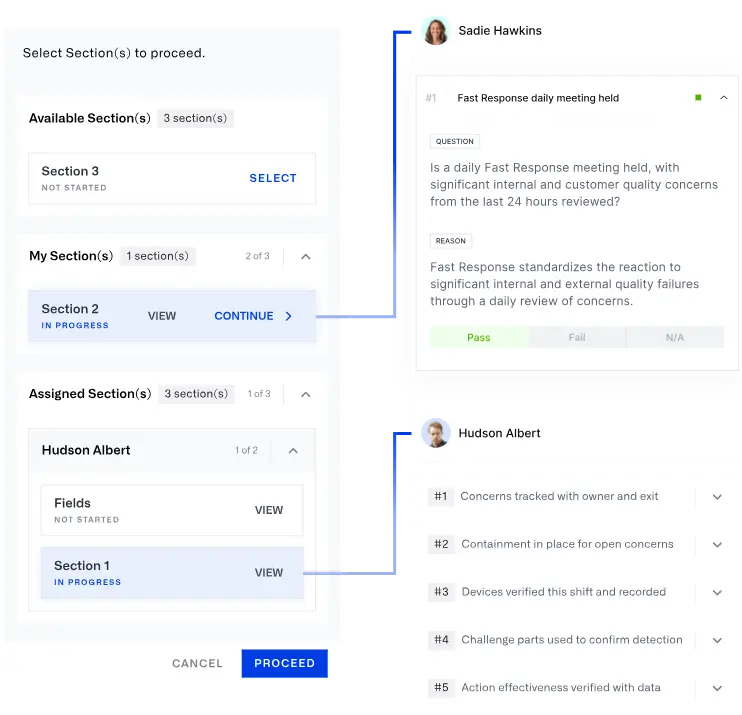
Multiple auditors work the same audit at once, each owning a section. No collisions, no overwrites, no waiting on one person to pull it together.

Hand off without breaking stride.
When a section changes hands, between shifts or between people, the next owner picks up what’s done and keeps going. Every handoff is captured in the audit trail.

Set the standard once. Scale it everywhere.
Define audit sections at the program level and every site inherits the same baseline. Local teams add what they need on top, without touching the locked standard.

Run the audit. Skip the wrangling.
And it all runs on the easy-to-use, closed-loop platform that manufacturers around the world love, so findings flow straight into the corrective actions, training, or follow-up that come next.
The frantic coordination. The chased-down inputs. The record stitched together at the last minute…
Gone.
In their place, one audit the whole team runs together, start to finish.
This is a big win for us. We can audit multiple units running the same process at the same time while maintaining a complete report for each one. That's a major improvement in how we execute audits.
Common Questions
Collaborative audits are audits that more than one person conducts together, because the scope is too large or too cross-functional for a single auditor. Common examples include automotive OEM customer-required quality audits, TPM autonomous maintenance audits on complex equipment, and multi-disciplinary safety and environmental reviews.
The audits that carry the most weight, like OEM customer audits, complex-equipment maintenance audits, and multi-disciplinary safety and environmental reviews, are too big for one person. Without a workflow built for several people, coordination falls to one person by hand. A workflow built for it keeps the audit coordinated and the record defensible.
When an audit takes several people, the work usually still runs through one. One person holds the master file, everyone else sends their parts by email or on paper, and the audit gets coordinated by hand. The record comes together after the fact, which leaves it scattered and hard to verify.
Most teams coordinate them manually. One person owns a master document or spreadsheet, others send their parts by email or on paper, and a lead compiles everything afterward. The work is shared, but the record is assembled after the fact, which makes it hard to show who verified what.
Section ownership means each section of an audit has one owner at a time. Auditors check sections in and out, so several people work the same audit without overwriting each other, and the audit trail captures who completed each section and when.
New collaborative capabilities allow multiple auditors conduct the same audit at the same time, with each section owned by one person. It turns audits that take a team into one coordinated workflow and one defensible record.
You define audit sections at the program or document level. Then during the audit, auditors check sections in and out, with one owner per section at a time, so several people work in parallel. Each section is submitted as it’s finished, the audit closes when all required sections are done, and the audit trail captures every handoff.
Yes. With EASE Collaborative Assessments, multiple auditors work different sections of the same audit at the same time. Each section has one owner at a time, sections are submitted independently, and the audit closes when all required sections are done.
Several auditors work at the same time instead of one piece at a time. Section ownership prevents collisions and overwrites, handoffs stay clean across shifts and people, the record holds together as the work happens, and a standard set once at the program level carries to every site.
Every section has a clear owner, and the audit trail records who completed each section and when. When an OEM auditor or registrar asks who verified a specific item, the answer is already in the record rather than reconstructed from separate files.
EASE’s new collaboration capabilities are built for checklist-driven audits that take more than one person, including automotive OEM customer-required quality audits (such as Ford Q1 and GM BIQS), TPM autonomous maintenance audits, ergonomic and station safety re-validation, and environmental compliance walks.
Yes. OEM customer audits are a great example of why you would use collaborative capabilities in EASE. Each subject-matter expert owns their section of the customer-required checklist inside one audit record, so Quality, Operations, Materials, and Maintenance work their parts at the same time and the audit comes together as one.
Yes. The full collaborative workflow works on mobile. Auditors claim sections, complete their work, hand off, view section results, and submit from the plant floor.
These capabilities are available in EASE PRO. It unlocks at the site level, so an organization can run it at the sites that need it.