Hoshin Kanri: A Guide to Turning Strategic Goals into Everyday Action

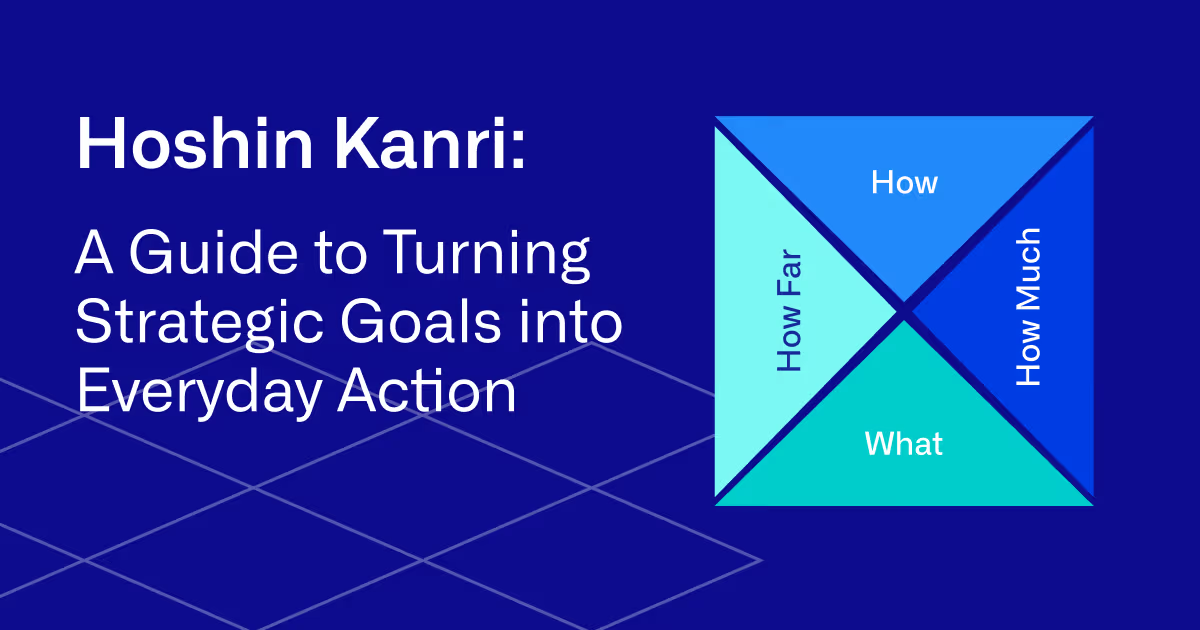
Factories succeed when everyone works hard toward the same priorities. But too often, strategic goals stay at the top of the org chart while daily operations follow a different rhythm.
That disconnect is what Hoshin Kanri helps organizations solve. Hoshin Kanri is a systematic method for translating a company’s vision into clear, measurable actions and processes that guide improvement for all employees.
Because as quality pioneer W. Edwards Deming once said, “If you can’t describe what you are doing as a process, you don’t know what you’re doing.”
With that in mind, let’s look at how Hoshin Kanri can turn strategy into measurable, visible actions across every level of a business.
What is Hoshin Kanri?
In Japanese, “Hoshin” means “direction” or “compass.” “Kanri” means “management” or “control.” Together, it’s about steering the business so everyone of all levels moves forward in the same direction.
Hoshin Kanri, also known as policy or strategy deployment, turns strategy into measurable actions that link leadership goals with everyday work.
To achieve this alignment, organizations rely on tools such as:
- The catchball process for two-way communication
- X-Matrix for visual goal alignment
- A3 reports for problem solving
- Bowling charts and KPIs boards for tracking progress
- Kanban boards to support continuous improvement
Origins of Hoshin Kanri
In the 1950s, Japanese companies rebuilding after World War II faced a daunting question: How do thousands of employees align on the same goals every day? Hoshin Kanri emerged as the answer. Japanese quality expert Yoji Akao developed Hoshin Kanri as a systematic approach to ensure every employee’s work contributes to the organization’s strategic goals.
His framework built on the quality principles introduced by W. Edwards Deming and helped turn vision into coordinated, measurable action. By the 1960s, companies such as Toyota, Bridgestone, and Komatsu had adopted and refined the method.
Hoshin Kanri builds on Lean and Six Sigma principles, overlapping with these and other continuous improvement frameworks in its emphasis on both the Plan-Do-Check-Act process and respect for people.
Key Steps in the Hoshin Kanri Process
Hoshin Kanri is like a factory machine for strategic planning; each gear connects to the next. When the gears mesh smoothly, strategy flows from vision to execution and back. Let’s explore the key steps or “gears”:
- Establishing a Vision and Breakthrough Objectives: Start with the “North Star.” What’s the long-term vision for five, ten, or even twenty years out? Maybe it’s achieving zero defects, carbon neutrality, or market leadership in a specific segment. From there, define breakthrough objectives that will take multiple years to achieve.
- Setting Annual Targets: Specific annual targets are like bite-sized chunks of the breakthrough objectives. For instance, a strategic objective of zero defects might translate into an annual target to improve first-pass yield by 10%.
- Deployment and the Catchball Process: Through the catchball process, senior management shares goals downward, while team members share feedback upward. On the factory floor, a production manager might review how a corporate safety target translates into daily operator checks. And instead of giving the operator instructions, they’d discuss how daily checks can support the target together.
- Implementation and Execution: With alignment secured, leaders assign accountable owners to execute the plan. Departments translate strategic goals and targets into actionable projects, standard work, and training plans. For instance, if a plant’s annual target is to reduce setup time by 10%, operators and engineers could meet weekly to observe changeovers. They could identify wasted steps and rearrange tooling layouts. Even small adjustments like pre-staging materials or using quick-release fixtures can add up to meaningful time savings over a year.
- Monitoring and Review: Regular reviews by frontline teams and supervisors track performance metrics to see if actions are delivering results. Visual tools like x-matrix diagrams and bowling charts help leaders see immediately if they’re on or off track. For instance, a packaging team might notice rising defect rates after a material change that causes their first-pass yield to drop below target. Using the Plan-Do-Check-Act (PDCA) process, they can experiment with new sealing temperatures and measure the results daily. After a week, the team might identify an optimal temperature range that restores quality without increasing cycle time.
- Adjustment and Continuous Improvement (Hansei): “Hansei” means self-reflection. If the company falls short of its goals, Hansei lets team members consider why and learn, without blame. Teams then apply continuous improvement to refine the next cycle.
Hoshin Kanri Tools
To translate strategy into daily execution, Hoshin Kanri relies on a set of structured tools. These tools are like the factory floor’s control panel for alignment and visibility:
-
X-Matrix:
The x-matrix is the visual centerpiece of Hoshin Kanri. It connects strategic goals (top), annual targets (right), key performance indicators (bottom), and accountable owners (left) in one chart for visible accountability. In a production meeting, for example, this allows everyone to see how their metrics ladder up to company strategy.
-
A3 Report:
The A3 report condenses problem-solving and planning onto a single A3-sized sheet (11×17 inches). It follows the logic of PDCA: clarify the problem, analyze causes, propose countermeasures, and sustain improvements through standard work. Many supervisors use A3s for tracking progress on their annual targets.
-
Bowling Chart:
This chart gets its name from its resemblance to a bowling scorecard and tracks monthly performance versus targets. Teams often use it to monitor KPIs such as safety incidents, original equipment effectiveness (OEE), or delivery reliability. A quick glance shows if you’re “hitting pins” or missing the mark.
-
KPI Boards:
On the factory floor, KPI boards often follow the Safety, Quality, Cost, Delivery, People (SQCDP) format. These boards display performance metrics for daily huddles. They link visual management to strategic planning.
-
Kanban Boards:
Kanban boards support continuous improvement by visualizing workflows and bottlenecks. When used alongside the x-matrix, Kanban connects daily activities to strategic goals by making priorities visible and filtering out unaligned work.
The Benefits of Hoshin Kanri
Implemented effectively, Hoshin Planning can turn strategic goals into practical action on the plant floor. Its benefits stretch across the business:
- Improved Strategic Alignment: Instead of top-down directives sitting on paper or in a presentation reserved for the board room, Hoshin Kanri ensures goals link directly to company vision. For instance, every shift lead would know exactly how their scrap reduction target connects to the company’s profitability objective.
- Increased Employee Engagement: The catchball process, where goals and ideas bounce back and forth between levels, builds ownership. Operators might help decide how to adjust audit frequency or modify standard work to streamline procedures in line with lean management practices. Compared with management forcing new requirements down to the front line, this process creates buy-in and strengthens trust.
- Optimized Resource Allocation: By focusing on a few breakthrough objectives, businesses avoid spreading team members too thin. They get to execute the critical few objectives all the way.
- Better Communication and Collaboration: Accountable owners get assigned to targets as part of the Hoshin Kanri planning process. Departments coordinate around shared performance metrics, not conflicting priorities. This promotes better teamwork and culture.
Hoshin Kanri in Practice
The benefits described above show up every day in organizations that use Hoshin Kanri to align strategy with execution. The following real-world examples illustrate how leading manufacturers put Hoshin Kanri principles into practice:
Toyota’s Use of Hoshin Kanri: Toyota’s approach to Hoshin Kanri embodies its commitment to continuous improvement. The company integrates Hoshin Kanri into its Toyota Production System, with each Toyota plant aligning its annual objectives with company-wide priorities. For instance, Toyota’s North America plant network has defined key initiatives like customer satisfaction, cost reduction, supplier enhancement, and people development.
Processes like catchball ensure ideas flow both ways from executives to operators and back. As an example, Toyota pairs Hoshin Kanri with gemba walks on the plant floor. This allows the voice of the operator and the reality of the production process to feed into strategy.
When assessing performance, the organization uses Hansei for collaborative, open reflection and learnings. Toyota then standardizes the insights it gathers and shares them across plants to support continuous improvement at scale.
Hoshin Kanri was critical for the business during disruptive events like the financial crisis of 2008 and the tsunami of 2011. It built resilience through alignment and standard routines.
Danaher’s Policy Deployment: Danaher uses Hoshin Kanri as a core element of its famed Danaher Business System (DBS), a management framework integrating lean thinking, continuous improvement, and disciplined strategy execution. Within DBS, Hoshin Kanri is the structured process for aligning long-term strategy with daily operations across hundreds of business units. Each operating company defines breakthrough objectives that guide multi-year growth or improvement goals and translates them into measurable annual targets.
At Danaher’s plants, the system comes to life through:
- Visible metrics using the X-Matrix
- Daily huddles
- Regular continuous improvement reviews
- Performance assessments
- Data-driven adjustments
Supervisors and operators track KPIs like first-pass yield, throughput, and downtime, directly linking them to broader strategic goals.
Whether integrating a new acquisition or managing an established facility, the process ensures everyone understands how their work drives strategic outcomes and helps reinforce continuous improvement.
Hoshin Kanri in Small-Medium Manufacturers
Hoshin Kanri isn’t just for large, global manufacturers. Because smaller manufacturers typically have flatter structures and faster communication, they can often implement Hoshin Kanri more effectively.
With fewer layers between leadership and the shop floor, strategic goals and priorities can be shared and refined quickly. The catchball process happens naturally in this environment and makes it easier to tie goals to real conditions on the plant floor. Smaller businesses also have less red tape when it comes to making decisions, so they can more easily course-correct before problems spiral.
Challenges and Considerations for Implementing Hoshin Kanri
Implementing Hoshin Kanri asks organizations to think differently about accountability, time, and culture.
Some challenges to consider before implementation include:
- Resistance to Change: When a new policy deployment process lands, many view it as “another management fad.” Showcase early wins to help overcome resistance to Hoshin Kanri initiatives. Also, show how catchball gives everyone at all levels a real voice in shaping work.
- Conflicting Goals: Without clear alignment, departments can pull in opposite directions. Use tools like the x-matrix to help make priorities visible to everyone.
- Time Commitment: Building a true strategy deployment rhythm takes time. The first few cycles may feel slow, but the payoff is huge.
- Integration with Other Systems: Many plants already use OKRs or the Balanced Scorecard that can feed into Hoshin Kanri. Use Hoshin Kanri to set direction, OKRs to define targets, and performance metrics to measure results.
- Tailoring to Culture: A Japanese factory with lifetime employees operates differently than a U.S. contract manufacturer. Adapt your language and cadence to fit culture.
- Psychological Aspects: Continuous improvement means learning. Encourage reflection in a blame-free environment (hansei) to ensure fear doesn’t hamper innovation.
- Aligning Strategy with Execution on the Plant Floor: Success comes from connecting the dots between the conference room and the gemba, where the work happens.
Using Plant Floor Audits to Reinforce Hoshin Kanri
Digital audit solutions like Ease help businesses operationalize Hoshin Kanri by linking strategic goals directly to everyday checks and actions. Let’s explore how this works:
- Aligning Strategy with Process Execution: Say your annual target is to cut scrap by 20%. Layered Process Audits (LPAs) can help monitor critical processes tied to outcomes, such as by verifying material setup or tool calibration.
- Generating Metrics for Monthly Reviews: When digital audit data feeds into key performance dashboards, businesses can access real-time feedback for reviews.
- Providing the “Check” Step: LPAs facilitate “Check” in the Plan-Do-Check-Act loop. They verify whether teams are following standard work on the shop floor.
- Driving Continuous Improvement: LPAs helped an EASE customer uncover and eliminate systemic quality issues that standard inspections missed. By tracking repeat findings across shifts, the team uncovered inconsistent processes and retrained operators to standardize work. The company turned isolated defects into organization-wide learning and continuous improvement.
- Reinforcing Quality Culture: LPAs make quality everyone’s job. When team members perform audits and discuss findings, it strengthens trust and accountability. The result is a workplace where strategic goals are part of daily routines and conversations, not abstract concepts reserved for the boardroom.
Final Thoughts
Hoshin Kanri helps businesses turn big goals into action. Manufacturers are under constant pressure to do more with less, and this approach bridges the gap between business goals and real-world action.
By connecting the dots of vision, annual targets, audits, and feedback, organizations learn faster and adapt quicker. All while never losing sight of their North Star.