Multilingual, Multi-Site, Multi-Standard: The Hidden Complexity of Global Quality Programs


Picture a global automotive supplier with plants on three continents. Every site is certified to IATF 16949, and several are also subject to VDA 6.3 audits from German automakers. Then there are the OEM audits like Ford Q1 and GM BIQS, each with their own cadence and criteria.
One corporate quality program is supposed to govern all of it. But what happens when sites in Michigan, Bavaria, and Guanajuato each audit against the standards slightly differently, in their own language and around their own operational constraints?
It’s why standardizing quality audits across multiple sites is such a thorny challenge, one that overlapping standards only make harder.
For quality leaders responsible for audit outcomes across a global footprint, the cost of this complexity stays mostly invisible until an external audit finding occurs.
Learn more about what inconsistency is costing you in our free eBook on Cost of Quality: The Hidden Truth About Your Most Important Operational Metric
Three kinds of complexity working in tandem
Three forces in particular make standardizing quality audits across multiple sites especially difficult:
- Language. A single plant can have two or more languages spoken on one floor, with a dozen languages spoken across the organizational footprint. Each language means a separate audit document to generate and keep current.
- Geography. 15, 50, or 100 sites means the same requirement can be read in multiple ways as each plant applies it to its own processes and equipment. Each site may also be subject to different regulatory and safety requirements that must be tracked and verified against.
- Overlapping standards. IATF 16949, ISO 9001, VDA 6.3, and customer-specific programs can all have requirements that apply to the same operation, each with its own evidence and scoring.
Where multi-site audit programs lose consistency
Complex, multi-person audits are one area where consistency tends to break down in global audit programs. Take customer-required quality audits, for instance.
Typically, corporate quality emails the audit document to each plant’s quality lead and hopes they receive consistent, reliable responses. Plants copy and paste the documents into their local systems. Version drift between sites becomes invisible until a customer audit catches it. It’s not malicious, it’s just that a corporate template rarely fits local reality.
The deeper issue is what happens to the record. When multiple SMEs contribute to a single audit via email notes and spreadsheets, the findings have to be assembled after the audit rather than captured as the work progresses.
No single, defensible record shows who verified what. Without this, when a registrar or customer auditor asks who signed off on a specific clause, the answer means cross-referencing a stack of files and emails.
The danger of relying on spreadsheets is that gaps usually become apparent only after you’ve already been hit with an external audit finding.
Balancing corporate standardization with site-level flexibility
Consistency at scale is a governance question for manufacturers under pressure to adapt to constantly changing standards, regulations, and customer-specific requirements. The big question is how to maintain standardization from a corporate perspective, while also giving sites flexibility to adapt audits to their operations.
When evaluating solutions to standardize complex team audits across multiple sites, look for a system that allows you to:
- Lock the standard at the program level: Admins define required sections and questions once at the program level, and every site automatically inherits that baseline, with no way to edit the locked parts from within an audit.
- Extend at the site level: Plants should be able to add their own sections and questions to fit their own local processes so they can execute with flexibility.
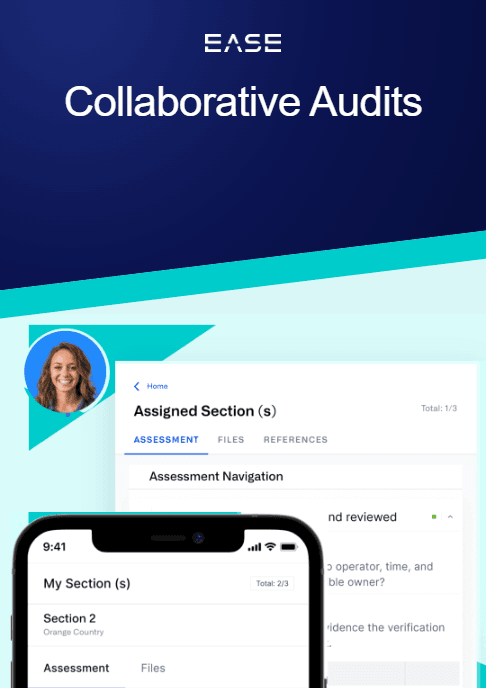
- Conduct different sections of the audit in parallel with clear section ownership: Several people can each take individual sections of the same audit and work on them at once. Each person owns a defined section, so the record always shows who completed which part.
- Roll up results across sites, standards, and languages: Results report upward in a consistent structure, so leadership sees performance from the top down and the plant floor up.
Consider a customer-specific audit like a Ford Q1, GM BIQS, or Stellantis SQA assessment. Audits like these span quality, manufacturing, materials, and maintenance, with a different SME responsible for each section. Historically, each tracked their piece separately before someone merged it all for reporting.
When those sections live in one audit record with a named owner for each, SMEs can work in parallel. When they need to hand it off to another person or shift, the next owner can pick up where the previous one left off. Handoffs are captured in the audit trail, with no colliding edits or changes lost. Each section is submitted as its owner finishes, and the sign-off stays traceable by section.
The result is one complete audit record, traceable by section, that a quality leader can walk a customer through without having to scramble to reconstruct details.
Taking the friction out of language and qualifications
Two recurring friction points in global audit programs deserve special attention, because standardizing the audit structure alone doesn’t solve them. One is language. The other is auditor qualification.
A single standard made up of dozens of documents can balloon into hundreds of versions once you account for every language and location. In the typical organization, each one has to be updated by hand when the standard changes.
With an automated system, built-in translation simplifies the process. You build the audit once, and each person conducts it in their own language, with no parallel library of documents to maintain.
Qualification is the second gap. Compliance-based programs require that whoever conducts an audit is actually qualified to do so at the time of the audit. Unfortunately for many companies, they don’t find out that an auditor wasn’t qualified until it comes up during an external audit while reviewing records.
The lesson here is that your system should check auditor qualifications when the audit is scheduled and flag any gaps immediately. That way, an out-of-date certification doesn’t potentially invalidate a year’s worth of audits.
Closing the loop on what audits find
Consistency is also about making sure that you have a closed-loop process for fixing problems that are identified throughout the audit process. Because the truth is, a finding that lands in a spreadsheet or someone’s inbox is a finding that may never get fixed.
Rather, you want to make sure your audit platform lets you:
- Connect findings directly to corrective actions, so every non-conformance is assigned to an owner and tracked to closure
- Assign targeted on-the-job retraining when audits identify a knowledge gap and verify the operator can perform the task correctly
- Track follow-up checks to ensure the correction holds over time
These elements are critical to prevent recurring problems. Furthermore, they also allow you to build a complete, defensible record that proves to customers and external auditors that plants are taking the right steps to reduce risk.
Consistency is a governance discipline
Global quality programs are inherently complex, and the pressures that make them so aren’t going away anytime soon. The key to managing compliance on a global scale is implementing systems and processes that keep audit reporting consistent across every site while complying with multiple standards and make it possible for teams to more effectively collaborate on large, multi-section audits.
It also requires a closed-loop process that standardizes how organizations track and route findings to corrective action. Problems can and will come up, but what matters is having the documentation to prove you’re managing them consistently.
Get these elements right, and global audit programs become a lot simpler. To manage, to scale, and to defend.