The Limits of Traditional Safety Programs and How AI Helps Solve Them

Since OSHA was created in 1970, worker deaths have fallen from 38 a day to 15, and injury and illness rates dropped from 10.9 per 100 workers to 2.4.
And yet we still see the headlines: a worker caught in an unguarded machine, a plant explosion that makes the evening news.
Traditional safety programs rely on inspections and walkthroughs, behavior-based safety (BBS), and creating a culture of safety to minimize risk. But even when all three work well, risks slip through.
The core problem: you only catch hazards that someone is there to see.
See what safety incidents really cost in The True Cost of Workplace Safety.
What scheduled inspections and walkthroughs miss
An inspection or walkthrough is a snapshot of a moment in time. A supervisor walks a route and logs findings on the cells she passes. The walk takes 20 minutes, but the shift runs eight hours.
The problem is that high-risk conditions still exist outside the inspection window, for example:
- Unguarded moving parts: Machine guarding is always on the list of top 10 OSHA violations, a problem that often happens when guards get bypassed or left off between scheduled checks.
- Equipment changeovers and maintenance: Risk increases anytime you have non-routine work on machinery. Like when an operator has their hands in the die space, and the press wasn’t locked out or blocked.
- Production pressure: People naturally look for shortcuts when the pressure to hit a delivery target is on, which are exactly the times a scheduled walk is least likely to happen.
A clean inspection record can be its own trap. Low injury rates and few findings can breed complacency, and companies sometimes discover a major hazard only after an incident has occurred.
Where behavior-based safety hits a ceiling
Behavior-based safety (BBS) is a process where trained employees observe their coworkers against a checklist of critical behaviors, log what they see on observation cards, and feed that data back to spot patterns.
Because the method is built to count individual behaviors, it measures what workers do, not the conditions shaping those choices. A guard that’s awkward to reposition or a line running behind schedule only show up if the program is built to look for them.
Three problems tend to come up as BBS programs scale:
- Observer subjectivity: Two people watch the same task and score it differently.
- Built-in underreporting: When a program rewards streaks of incident-free days, nobody wants to break the streak, so near misses go unlogged.
- Quota pressure: Observation targets meant to drive participation can produce rushed cards that hit the number without improving safety.
Why a culture of safety isn’t enough
If inspections and BBS are about catching problems, safety culture is about preventing them, by focusing on the attitudes and habits around working safely even when no one’s watching. The emphasis moves from rules and finger-pointing to shared ownership.
But even where people value safety and feel free to speak up, mistakes still happen. People don’t always make the right call in the moment, especially under pressure or fatigue.
The real issue is that safety is a systems problem. Culture decides how people respond to what they see. It can’t, on its own, widen what they’re actually able to see.
From periodic checks to continuous safety monitoring
Inspections, BBS, and safety culture are the foundation of a strong safety program. AI now lets companies build on that with continuous monitoring that runs every shift, as opposed to just collecting observations when someone’s on the floor.
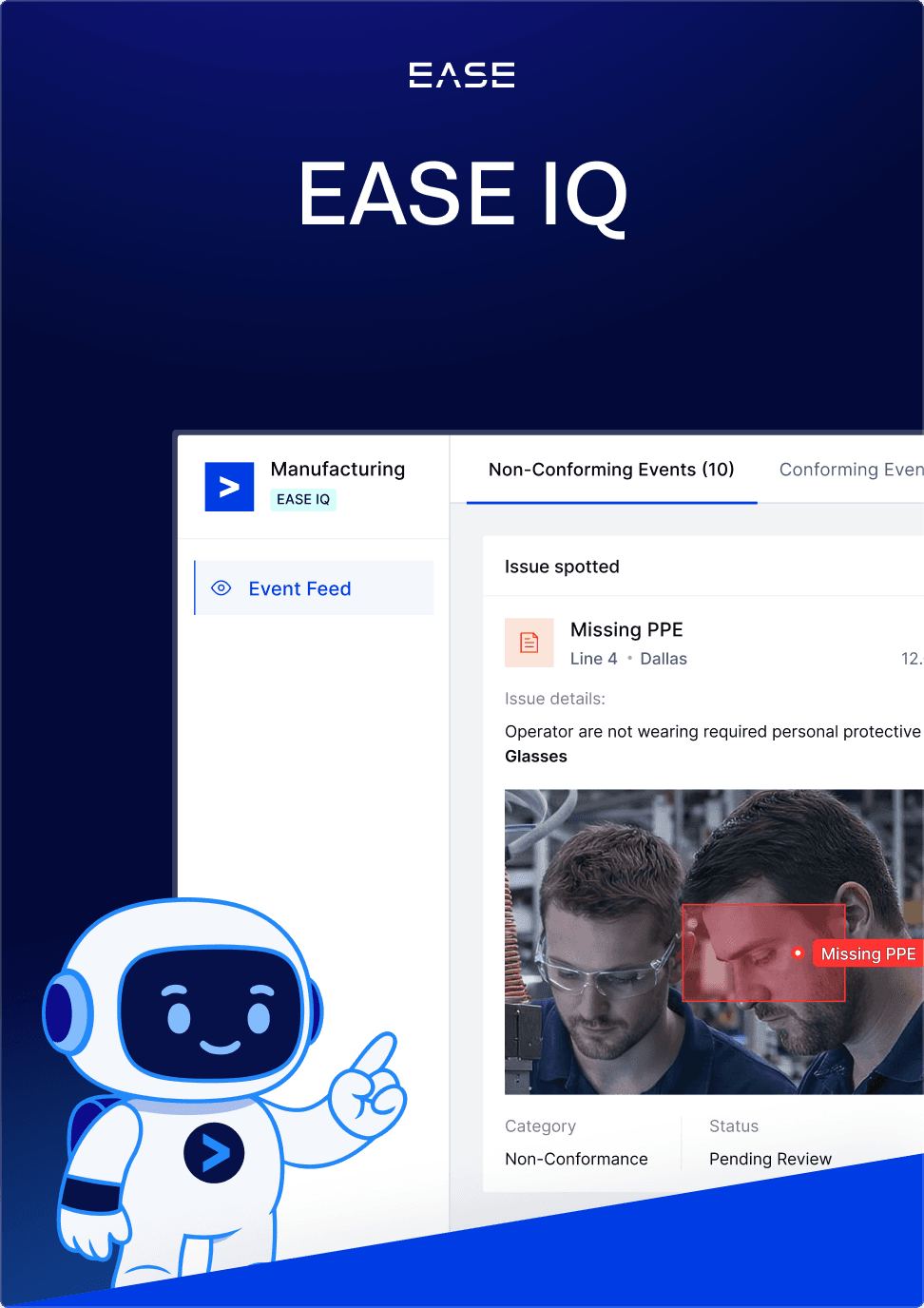
Agentic AI systems equipped with camera vision watch the production line 24/7 and flag unsafe conditions as they happen, for instance:
- A worker steps into a cell to clear a jam without locking it out.
- An operator runs a press with the guard left open to speed up a changeover.
- An employee at a grinding station skips eye protection.
When an unsafe act or condition is identified, the system routes it to the right supervisor and opens a corrective action according to pre-determined rules and workflows. It also tracks that action all the way through to verification, so that a hazard reported at 2 p.m. doesn’t sit waiting for someone to fix it.
Where traditional safety programs go from here
Safety inspections, BBS programs, and creating a culture of safety are all critical parts of a safe workplace. But each one still depends on the right person being in the right spot at the right moment to notice when something’s wrong.
That’s where manufacturers are leveraging AI to further drive down safety incidents on the plant floor. People still own the judgment calls and the safety conversations. Continuous safety monitoring just expands visibility into the gaps between checks. The result is a safety program that sees the bigger picture and not just individual moments in time.